The short answer
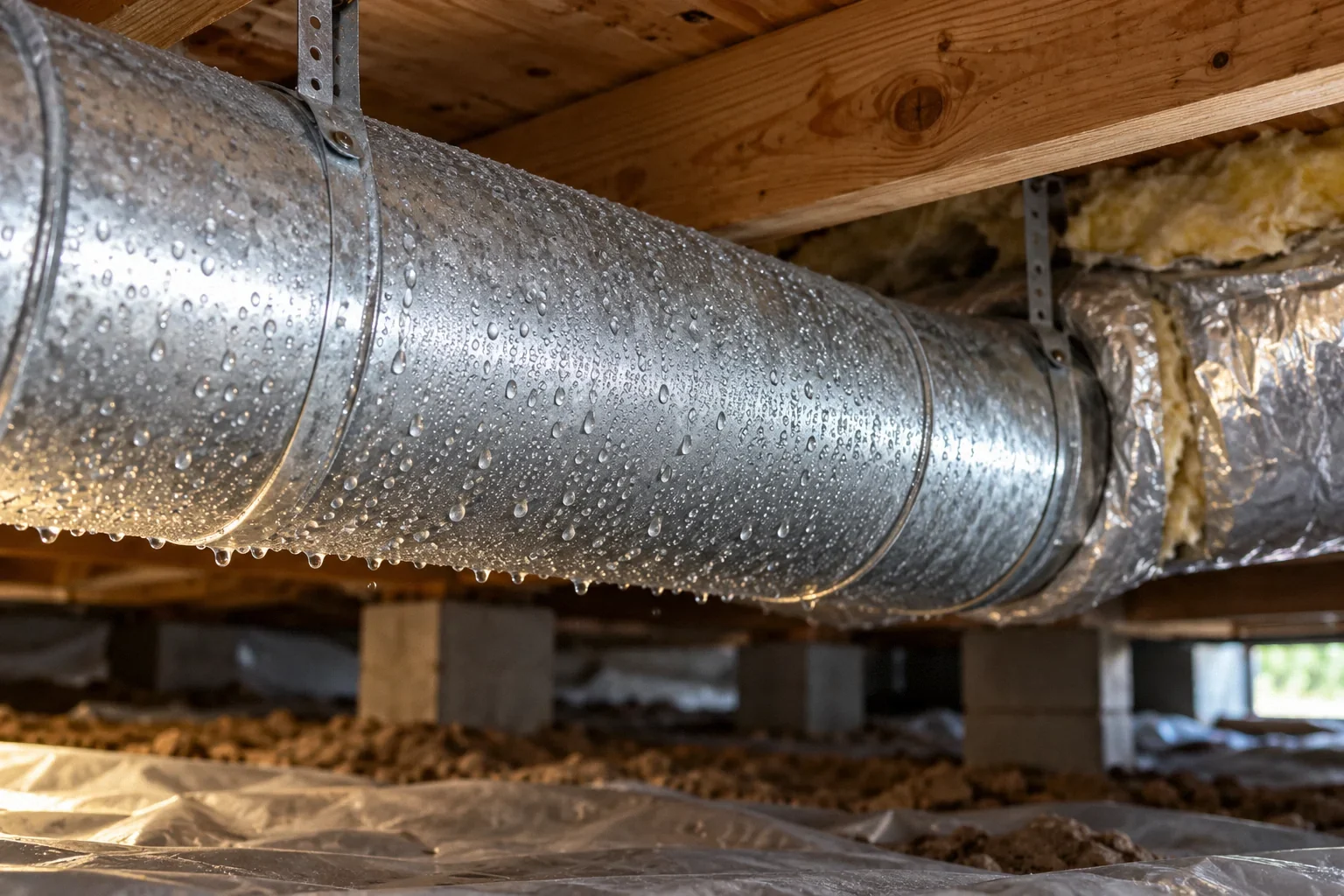
Crawl space ductwork sweats when moist air encounters a duct surface cold enough for condensation. High crawlspace humidity, damaged insulation, an open vapor jacket or air leakage can contribute. First determine whether the water follows cooling operation, rain or a plumbing event. The appropriate response may involve both the duct assembly and crawlspace moisture control. Adding insulation over a wet or defective assembly is not a reliable diagnosis.
US general planning; local code examples and manufacturer-specific requirements are identified where used.
Confirm where the water first appears
Water beneath an air duct does not automatically originate at that duct. A plumbing line above it, a condensate connection or rain entering nearby can wet the same area. From a safe accessible location, note whether droplets form on the duct surface, whether insulation is saturated at a seam, or whether water runs onto the assembly from somewhere else.
Record the time and whether cooling is operating. A photograph showing the first wet location is more useful than one taken after water has spread over several surfaces. Also note whether the symptom appears only in particular weather. Do not disturb wiring or reach into standing water to obtain a better view. The purpose of this first pass is to give the HVAC or moisture specialist a plausible starting point without deciding the cause prematurely.
Understand the cold-surface mechanism
Air can contain enough water vapor that cooling it near a surface produces liquid droplets. The surface does not need to be freezing. Supply ducts carrying cooled air can become the coldest exposed surfaces in a crawl space, especially where insulation is absent or compressed. Humid outside air entering through vents can increase the available moisture.
DOE’s metal-duct insulation guidance explains that ducts in unconditioned spaces need both thermal insulation and a vapor-control covering. The insulation limits heat transfer, while the exterior covering restricts humid air and vapor from reaching colder parts of the assembly. These functions are related but different. A thick blanket with an open seam can still have a weak point. Likewise, a good-looking outer jacket does not establish that the insulation underneath is dry and properly supported.
Look for defects that a larger dehumidifier will not repair
Ask the HVAC technician to check the duct connections, boots and transitions as well as long straight runs. Tears in the outer jacket, compressed insulation at supports, exposed metal and poorly closed seams are useful observations. Air leakage also deserves attention because it changes the duct system’s performance and may create localized cold areas.
Do not assume every irregularity requires replacing the entire system. The assessment should identify which defects are present, whether insulation has become wet, and what repair method the actual duct product permits. Wrapping another layer over a wet assembly can conceal the condition and complicate future service. Request photographs before the repair is closed. They help distinguish a documented correction of a specific defect from a general recommendation to add more insulation everywhere below the house.
Assess the surrounding crawl space at the same time
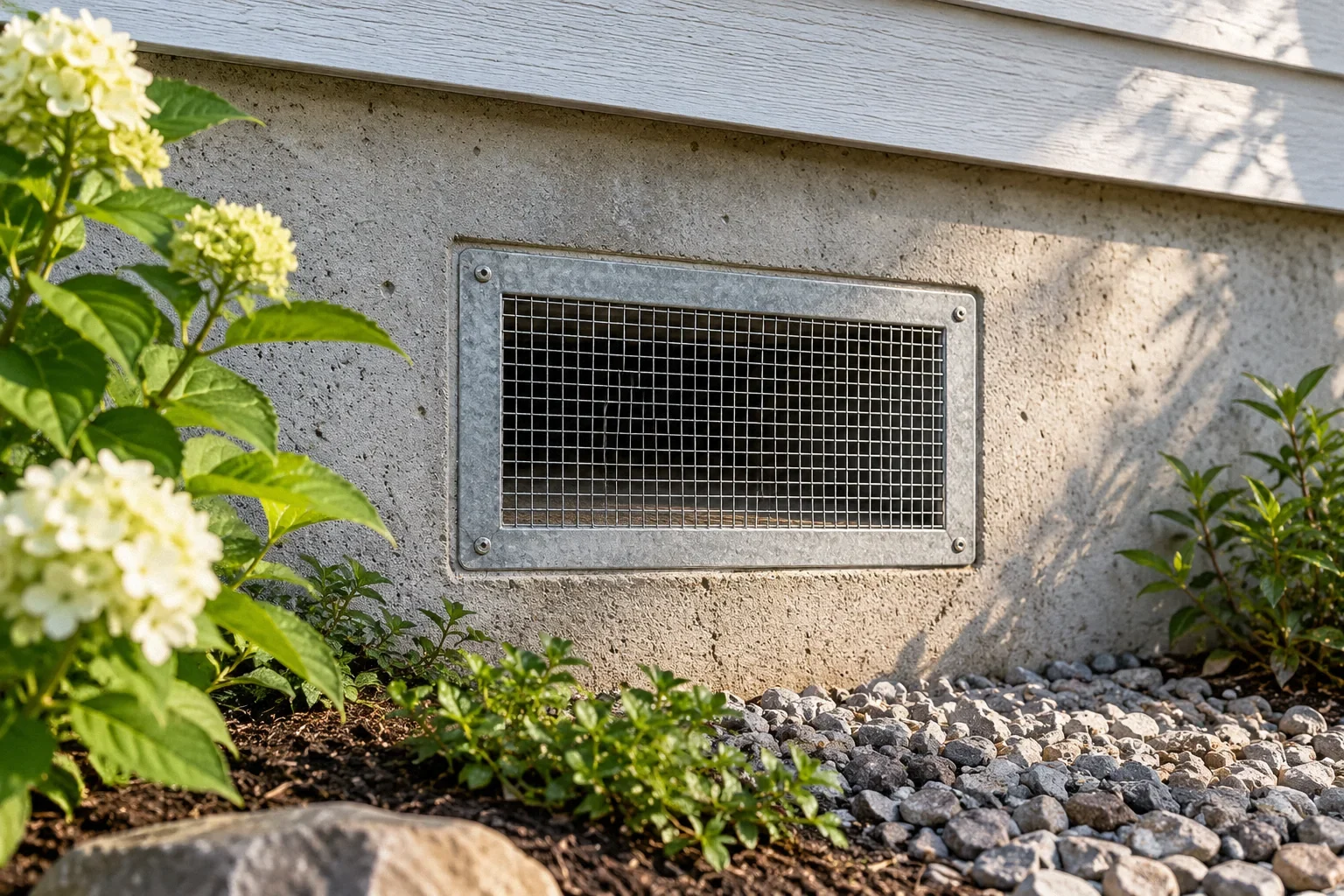
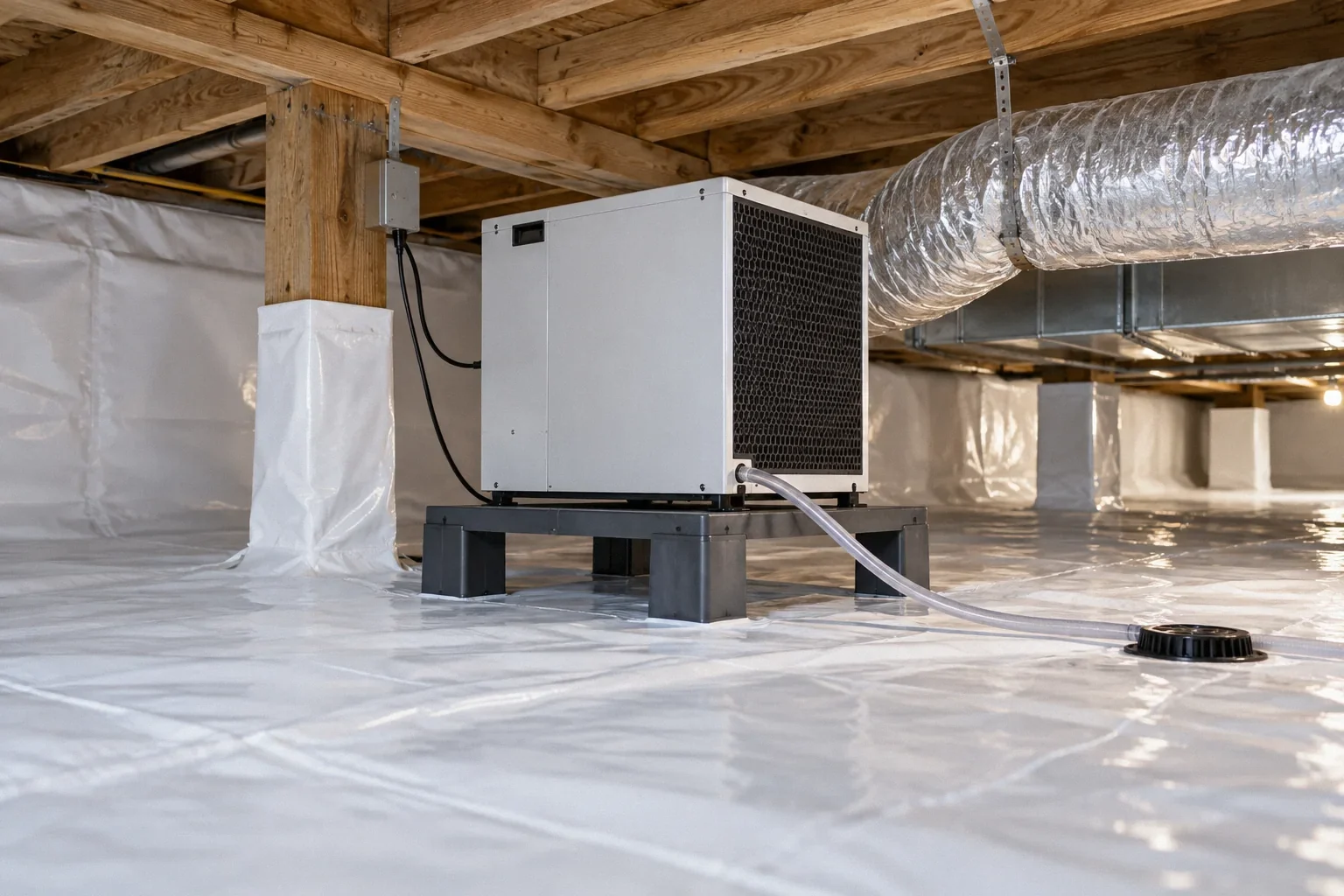
A sound duct assembly still operates within the conditions around it. Examine whether the ground cover is continuous, whether there is visible water and how outside air enters. Note if the crawl space has been partly enclosed without a complete drying plan. A fan that moves outdoor air through the area may help under some conditions and worsen moisture loading under others.
DOE’s unvented crawlspace guide describes why humid air entering a cooler space can cause condensation on framing and services. Use that principle to frame questions, not to conclude that every sweating duct requires encapsulation. The specialist should explain whether ambient moisture is unusually high, whether the duct defect alone is sufficient to explain the symptoms, and whether the two issues need coordinated work. Solving only one can leave the other visible after the repair.
Treat wet materials as a separate follow-up
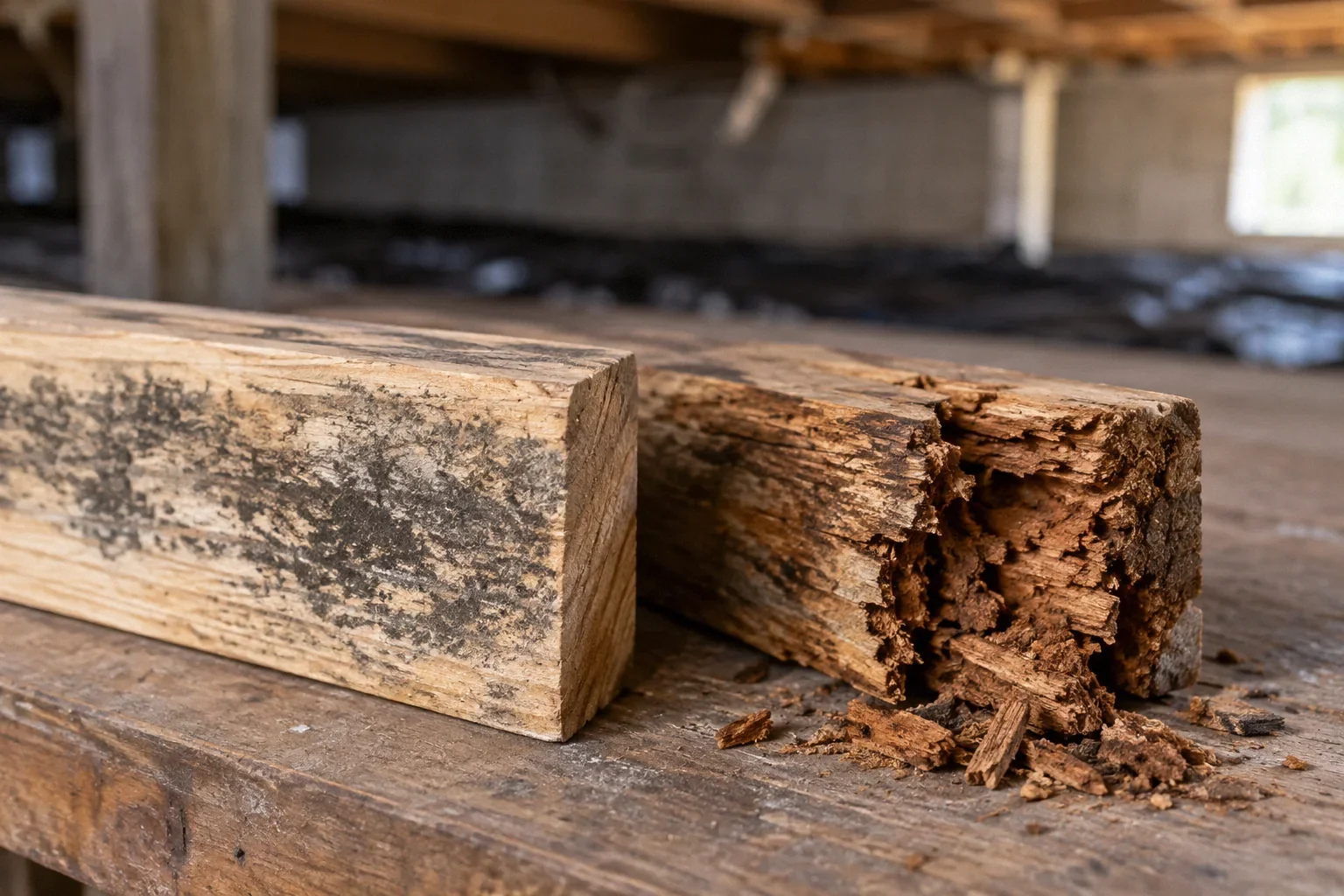
Stopping new droplets is not the same as establishing that everything already wetted is acceptable to leave in place. Insulation, adjacent wood and finishes may have different drying and cleaning needs. Record the extent of the affected area before it is hidden again, and ask whether any material must be removed for inspection or effective drying.
EPA’s residential mold guidance emphasizes correcting moisture and addressing contaminated materials rather than merely covering growth. Suspected contamination of the HVAC system deserves professional evaluation; it should not be spread by continuing operation without review. Surface color cannot establish the organism or the condition of structural wood. If framing condition is questionable, the appropriate in-person assessment is separate from the duct repair. The scope should state how those findings are handled instead of assuming the HVAC contractor’s work resolves every consequence.
A hypothetical leak with two contributing causes
Suppose droplets appear along a supply trunk only while air conditioning runs. Most of the duct is dry, but one support compresses the insulation and an adjacent jacket seam is open. The crawl space also has humid summer air entering through ordinary vents. A technician documents both the local assembly defect and the surrounding conditions.
Repairing the support and jacket may stop the localized dripping, while the owner still needs a broader moisture review if joists elsewhere remain damp. Alternatively, correcting room humidity alone might improve the symptom without fixing a defect that returns during more humid weather. This hypothetical example explains why “duct problem” and “crawlspace problem” are not always competing diagnoses. A useful repair proposal names the specific contribution of each and describes how the result will be checked.
Verify under the conditions that caused sweating
After repair, compare observations during similar cooling operation and humid weather. A dry duct on a mild day is encouraging but may not challenge the assembly in the same way. Keep the original locations marked on a sketch and note whether condensation has stopped there or shifted to another part of the system.
Ask for the installed materials and repair method to be recorded, including any replaced insulation and jacket treatment. Confirm that ducts remain supported and accessible and that nearby condensate drains function as intended. If symptoms recur, share cooling status, weather and the first visible wet location rather than only the total amount of water. That record supports a more focused reassessment. It also helps avoid repeatedly replacing unrelated components because the original mechanism was never verified.
Before your next decision
- Record the first wet location and cooling status.
- Compare symptoms with rain and plumbing use.
- Request inspection of seams, supports, boots and insulation.
- Assess ground moisture and outdoor-air entry separately.
- Document cleanup or replacement of affected materials.
- Recheck under comparable humid cooling conditions.
Related questions
Should I insulate the ducts or lower humidity first?
Both may be relevant. Document insulation and jacket defects while assessing the surrounding moisture load. Active liquid-water sources should be corrected, and the repair sequence should avoid covering wet materials.
Is condensation proof that the air conditioner is too large?
No. Duct surface conditions, insulation continuity, surrounding humidity and leakage can produce condensation without establishing equipment-sizing problems. An HVAC assessment needs more information than a photograph of sweating ducts.
Can I tape over a wet duct jacket?
A patch should follow the actual duct product’s repair instructions and should not conceal saturated insulation or an unresolved source. Have the affected assembly evaluated before treating visible tape damage as the entire problem.
Sources & further reading
- U.S. Department of Energy / Pacific Northwest National LaboratorySealed and Insulated Metal Ducts
Metal duct leakage, insulation and exterior vapor-jacket continuity.
- U.S. Department of Energy / Pacific Northwest National LaboratoryUnvented, Insulated Crawlspaces
Closed crawlspace systems; construction guidance with multiple code editions, not proof of locally adopted code.
- U.S. Environmental Protection AgencyA Brief Guide to Mold, Moisture and Your Home
Residential mold prevention and cleanup; health advice must remain bounded.
Homeowner questions behind this article
These discussions informed the questions, not the technical answers. Some were available through indexed excerpts; votes and comments are not an engineering assessment.
Research method