The short answer
Mold, fungal staining and wood decay are related to moisture but are not interchangeable findings. Surface growth does not by itself establish loss of structural strength, while apparently limited discoloration cannot rule decay out. A crawlspace assessment should identify the water source, evaluate affected materials and separate cleanup needs from framing condition. Chemical treatment or encapsulation alone does not prove that damaged wood is sound.
US general planning; local code examples and manufacturer-specific requirements are identified where used.
Separate three questions that are often combined
An owner seeing growth on joists usually wants to know whether the house is safe, whether the air is unhealthy and how to stop the problem. Those questions can require different evidence and different professionals. A cleanup recommendation does not automatically answer the structural question, and a statement that framing remains usable does not establish that moisture or contamination needs no attention.
Write down the actual finding rather than translating every dark mark into “rot.” Ask whether the observation is surface growth, staining, suspected decay, insect damage or an uncertain condition needing further evaluation. The report should identify the location and limits of inspection. A crawl space that could not be fully accessed has an inspection limitation, not a verified clean bill of health for the concealed portion.
What wood science says about growth and strength
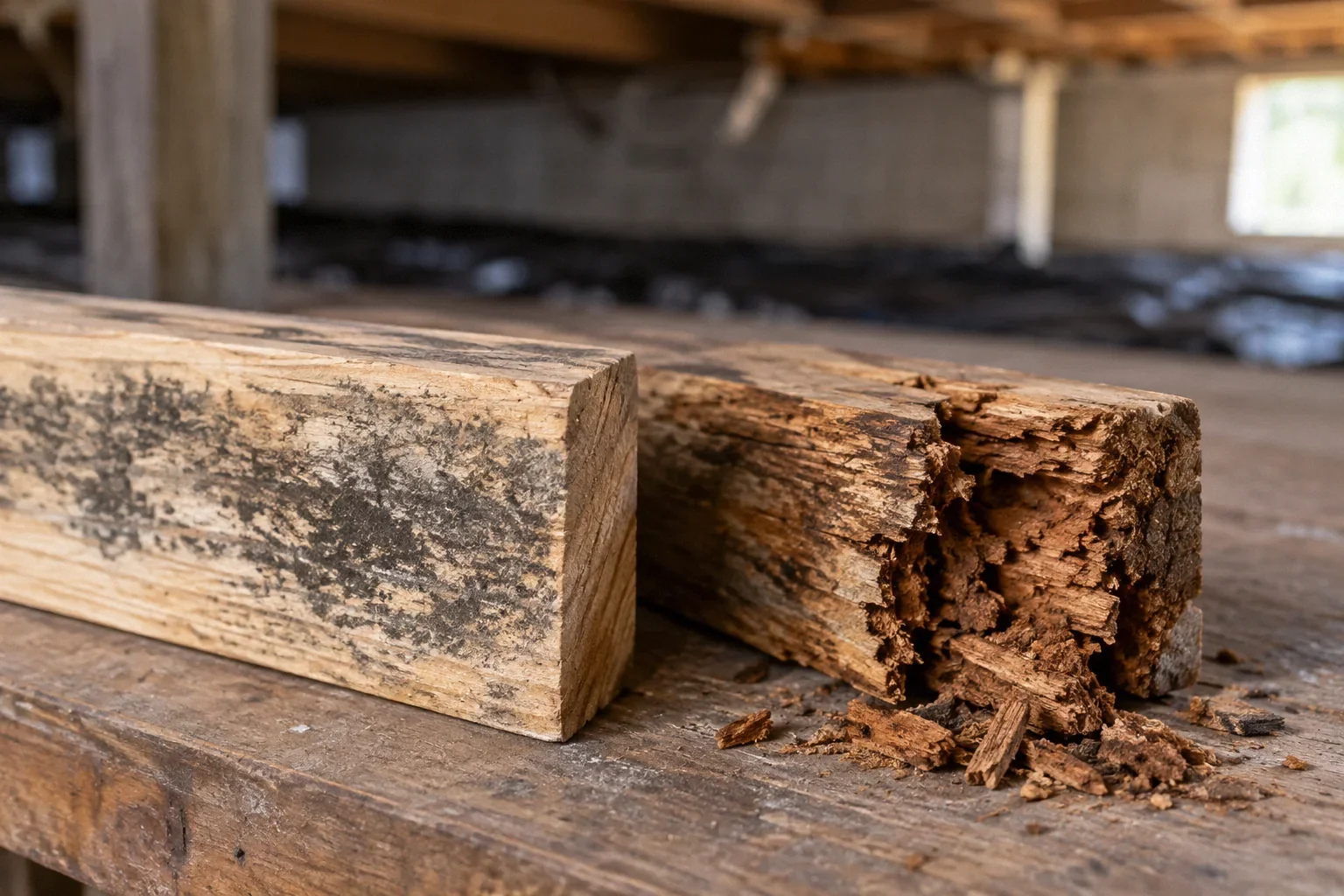
The USDA Forest Products Laboratory’s wood handbook distinguishes molds and fungal stains from decay. Ordinary mold and stain effects on wood differ from the damage caused by organisms that break down its structure. The distinctions matter because the required response should follow the actual condition rather than the color of a patch.
That reference is not a way to identify an organism from a phone photograph. More than one process can be present, and an older stain can overlap a newer wetting event. Lighting and surface treatments can also change appearance. Ask the assessor to explain what supports the finding and whether structural condition remains uncertain. Where strength or connections may be affected, obtain an appropriate in-person framing assessment rather than accepting a chemical product label as evidence that the wood is adequate.
Find the moisture history, not just today's number
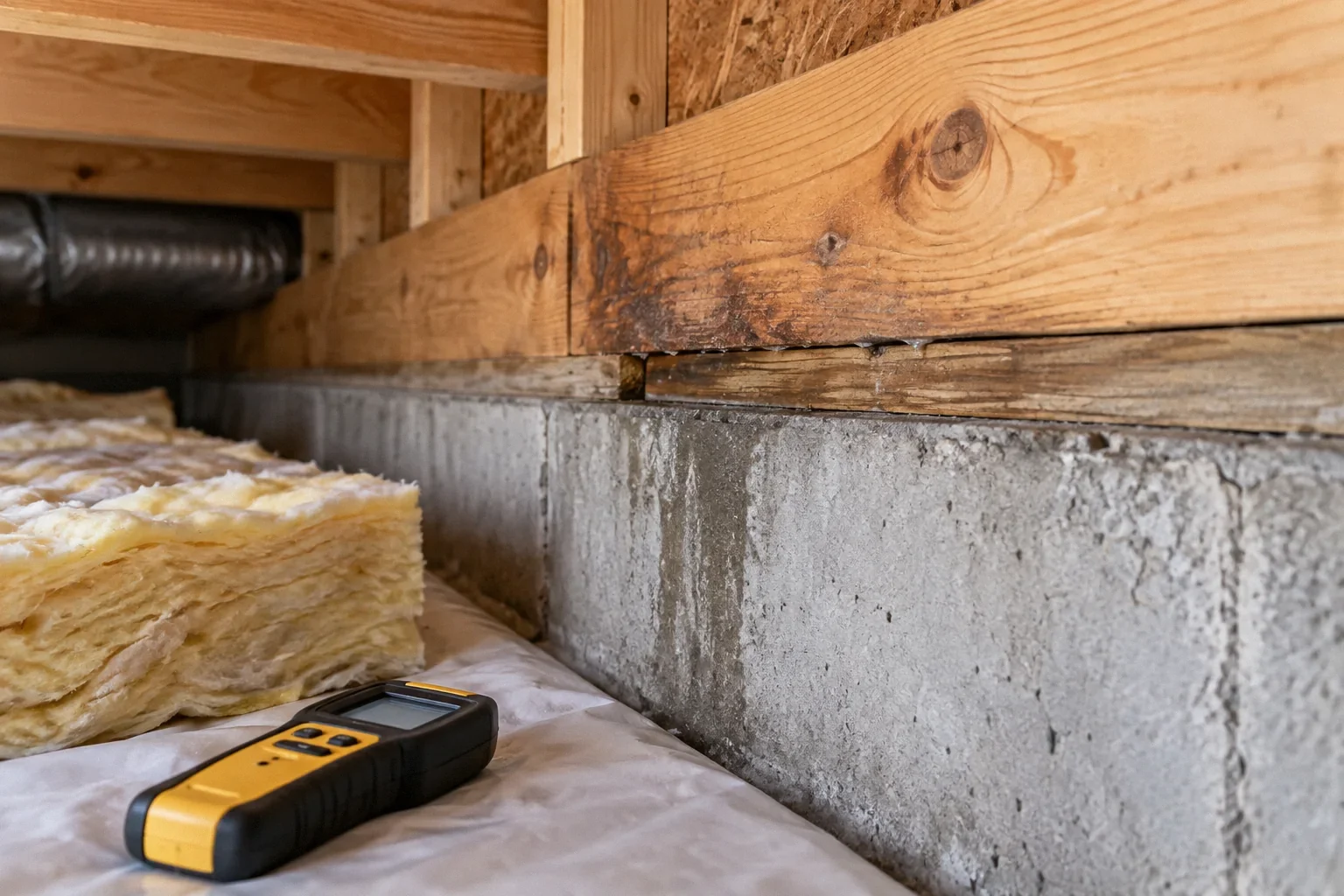
A wood-moisture reading can be useful, but it is a measurement at a location and time using a particular instrument. It does not reconstruct every previous wetting event. Record the date, approximate location and conditions when readings were taken. Measurements from several accessible areas are more informative than one number offered without context.
Compare the record with rainfall, plumbing repairs, cooling operation and visible waterlines. A dry reading after a leak was fixed may coexist with damage that occurred earlier. Conversely, a high reading deserves investigation without implying a particular amount of strength loss. DOE’s existing-crawlspace guidance calls for water management before enclosure and monitoring afterward. This supports a sequence in which the source is corrected and material conditions are evaluated, rather than a sequence that simply covers the evidence with a new liner.
Keep cleanup scope separate from framing scope
Ask a remediation provider what material will be cleaned, what will be removed and what cannot be reached. A treatment proposal should explain how moisture recurrence will be prevented and how the work area connects to the occupied house. If the provider sees suspect structural wood, the proposal should identify the need for a separate assessment rather than quietly treating it as another surface.
EPA’s residential mold guide emphasizes fixing the water problem as well as addressing mold. It also identifies circumstances in which professional help is appropriate, including extensive damage and suspected HVAC contamination. A homeowner does not need a species name to take an active moisture problem seriously. Nor should a reassuring color description substitute for evaluating the extent of affected material and the exposure pathways that matter in the particular house.
Compare recommendations by their unanswered questions
Scroll horizontally to read every column.
| Recommendation | Useful question | Evidence to request |
|---|---|---|
| Apply a treatment | What condition is being treated, and what remains afterward? | Locations, product purpose, preparation and cleanup scope. |
| Encapsulate | How will existing water and affected wood be evaluated first? | Drainage findings, material assessment and drying plan. |
| Replace framing | What finding establishes the need and extent? | An appropriate structural evaluation and repair design. |
| Monitor only | What changes would trigger action? | Baseline observations, measurement locations and a follow-up plan. |
The table does not rank these responses. Several may be necessary, and none is complete merely because a different provider proposed something more expensive. The comparison should expose missing evidence and clarify who is responsible for resolving it.
A hypothetical dry reading with an old leak
Suppose a pest inspection records normal-looking moisture readings on several joists but also photographs a discolored area beneath a repaired bathroom leak. One company recommends spraying the entire crawl space, while another recommends immediate replacement of a large framing area. Neither recommendation is adequately explained by the moisture reading alone.
A focused next step is to establish the leak history, document the affected members and have uncertain wood condition evaluated appropriately. Cleanup may still be necessary even if the framing is retained. Structural repair may still be necessary even if the wood has since dried. This hypothetical case illustrates why current moisture, contamination and structural capacity should remain separate findings. Combining them into one word such as “fungus” makes it harder for the owner to understand what the proposed work will actually accomplish.
Close the work with a record that survives concealment
Before new insulation or a liner changes access, photograph the areas inspected and record any unresolved limitations. Keep the moisture-source repair, cleanup scope and framing evaluation together, while distinguishing what each document verifies. If replacement or reinforcement was necessary, retain the relevant design and completion records rather than only the invoice for a surface treatment.
The follow-up should ask whether wetting has returned and whether the controlled conditions persist. Do not expect every historical discoloration to disappear or use appearance alone as an acceptance test. Likewise, a fresh coating should not obscure the locations that need future observation. A useful record lets a later inspector understand what happened, what was corrected and what remains accessible for maintenance. That is more valuable than a broad promise that the space has been “sterilized.”
Before your next decision
- Request precise findings instead of an undifferentiated mold/rot label.
- Record access limitations and measurement locations.
- Identify present and past water sources.
- Separate cleanup from structural assessment.
- Resolve suspect conditions before covering the framing.
- Keep a follow-up record tied to rainfall and equipment operation.
Related questions
Does black growth mean dangerous structural rot?
Color does not establish the organism, health risk or remaining wood strength. Document the moisture source and extent, and obtain the appropriate material and structural evaluations where those questions remain uncertain.
Will encapsulation kill existing mold?
Encapsulation changes moisture and air control when properly designed. It does not automatically clean affected materials or establish framing condition. Existing contamination and damage need their own scope.
Can dry wood still need repair?
Yes. Drying stops one enabling condition but does not reverse past loss of material or connection damage. Current dryness and structural adequacy are separate findings.
Sources & further reading
- USDA Forest Service, Forest Products LaboratoryBiodeterioration of Wood, Chapter 14 of the Wood Handbook
2021 wood-science reference, including mold, stain, decay and insects.
- U.S. Environmental Protection AgencyA Brief Guide to Mold, Moisture and Your Home
Residential mold prevention and cleanup; health advice must remain bounded.
- U.S. Department of Energy / Pacific Northwest National LaboratoryWater Management of Existing Crawlspace Floor
Existing crawlspace moisture retrofit; not excavation instructions for homeowners.
Homeowner questions behind this article
These discussions informed the questions, not the technical answers. Some were available through indexed excerpts; votes and comments are not an engineering assessment.
Research method