The short answer
Do not enter an unknown underground chamber because it looks dry, contains old supplies or has a pipe that might be a vent. Its identity, structure, atmosphere, access and utilities may be uncertain. Start with property records and observations from a safe location. Have appropriate professionals assess entry and condition before treating it as storage, a renovation opportunity or a household shelter.
US public guidance and homeowner planning. Follow current local emergency instructions; property-specific suitability requires qualified assessment.
An intriguing discovery is not an identification
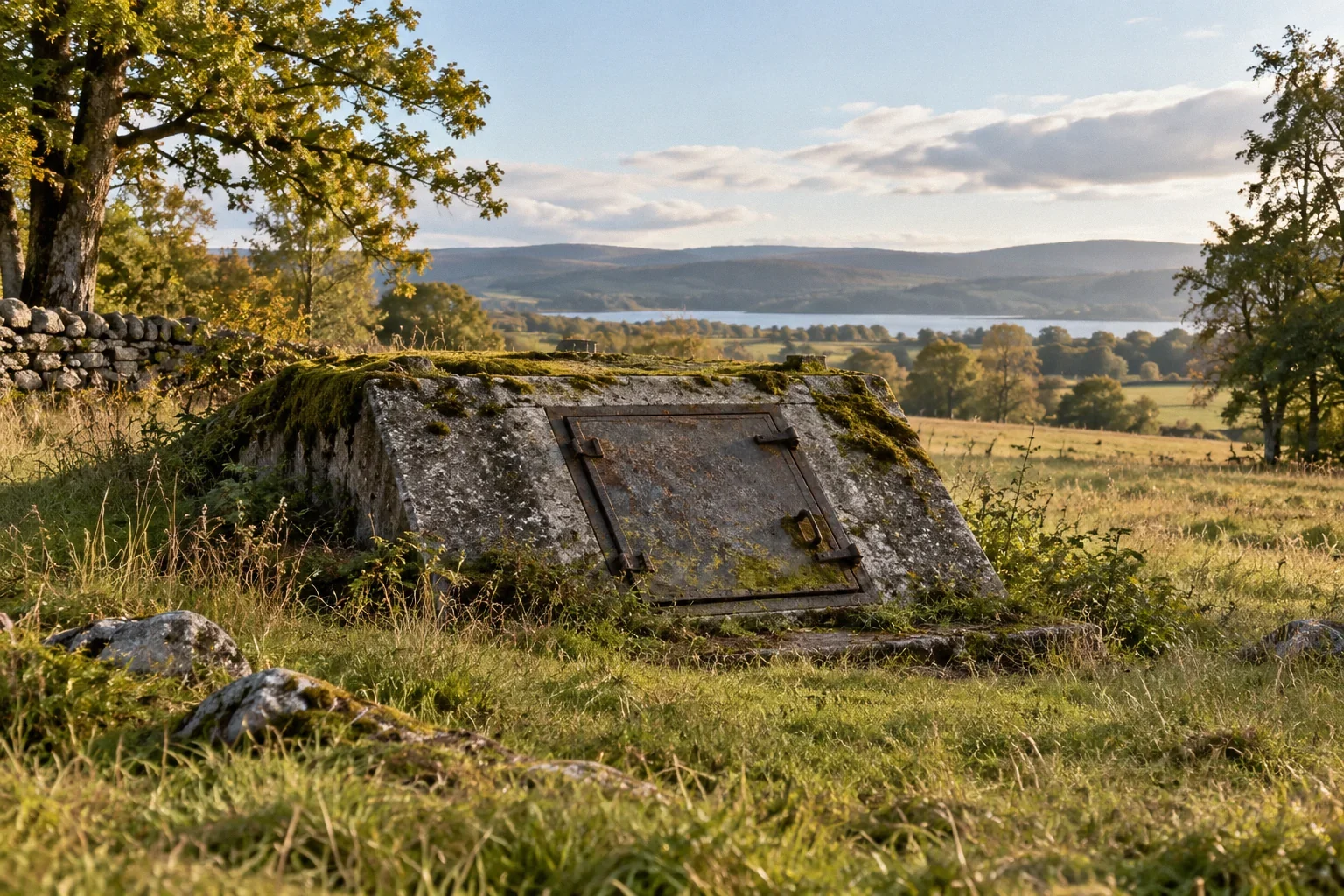
Property owners sometimes discover a covered opening, a concrete room or a chamber described by a former owner as a bunker. Old bottles, a light fitting or a heavy hatch may suggest a story, but they do not establish what the structure was built for or whether it remains usable.
Keep the opening secured against accidental access without creating another hazard. Record its location and safely visible features. Do not remove structural covers, descend a shaft or disturb unknown pipes to investigate the story yourself. A buried tank, utility vault and occupied shelter can look similar from a limited view. Correct identification affects the professionals, records and precautions needed for the next step.
Start with records that can narrow the possibilities
Gather available property plans, permit history, surveys, prior inspection reports and any documents supplied at purchase. Ask the appropriate local office about historical records and relevant utilities or former site uses. Treat a neighbor's recollection as a lead to investigate rather than verified construction history.
Organize the records around specific questions: approximate age, original purpose, dimensions if documented, access location and connections to other systems. Note conflicts instead of choosing the most appealing explanation. An old plan may show a structure that was later altered, filled or partly demolished. The professional assessment needs both the paper history and the current condition; neither should silently substitute for the other.
Atmospheric hazards may not announce themselves
OSHA: Confined Spaces: Overview explains why spaces with restricted entry and potential atmospheric or other hazards need careful evaluation in workplace contexts. An underground chamber's lack of odor, a sensation of moving air or an old occupant's story does not establish safe entry now.
Do not rely on a candle, a pet, a phone sensor or an unverified consumer detector to test the space. A single reading also does not resolve all possible structural, electrical and access hazards. Appropriate professionals must determine the entry approach and equipment for the actual conditions. If someone is in distress inside, contact emergency services and do not create another casualty through an improvised entry. An unknown atmosphere is not a homeowner trial-and-error project.
Construction safety and future occupancy are different assessments
OSHA: Confined Spaces in Construction describes hazards associated with confined spaces during construction work. Its workplace requirements have a particular scope and should not be presented as a general homeowner occupancy permit. Nevertheless, the hazard distinction matters when a contractor proposes entering, cleaning or renovating an old chamber.
Ask the contractor how entry conditions will be evaluated and controlled before work begins. Separately ask what would be required for the finished space's intended use. Successfully entering to inspect something does not establish that a family can occupy it during an emergency or that it may become a bedroom. The completed use can require a different design, approvals, systems and access arrangements from those needed for a controlled professional inspection.
Assess the structure and water history before finishes
Once safe assessment access has been established by the appropriate team, investigate the enclosure, supporting ground, roof, openings and signs of alteration or deterioration. The evaluation should identify what is known, what is concealed and what further investigation would change the conclusion.
Include the surrounding site and water history. A chamber may be dry because recent weather has been dry, because a former drainage system still works or for another reason that has not been established. Do not assume that cleaning and painting create a suitable occupied room. Likewise, old electrical equipment or a floor pipe should not be energized or connected simply because it appears intact. Identify each system and have it assessed for the proposed use.
An old shelter label does not document current protection
FEMA: FEMA P-361: Safe Rooms for Tornadoes and Hurricanes (April 2025) provides modern guidance for storm safe rooms, with attention to the complete enclosure and its operation. An old room called a fallout shelter or storm cellar is not automatically documented to those criteria. The intended hazard may also have been different.
Ask what evidence exists for the original design and whether a qualified assessment can establish a useful current role. The answer may be limited storage after suitable work, a different conversion, or a recommendation not to use the space. Keep those possibilities open. Romanticizing the discovery as a valuable bunker can pressure the owner into defending a use before the facts have been established.
A hypothetical renovation quote begins too far ahead
A buyer discovers an underground chamber and receives a quote to remove debris, install lights and paint the walls. The quote assumes the room is a former shelter but includes no identity, entry or condition assessment. The buyer is tempted because the visible work seems modest.
The useful next step is to resolve the unknowns before accepting that cosmetic scope. Professionals may need records, safe access planning and condition investigation. If the space is eventually considered for regular use, EPA: Radon When Buying a Newly Built Home also illustrates why radon testing remains relevant even where construction features appear protective. This hypothetical does not identify any real chamber; it shows why a tidy finish should be the result of a suitability decision, not its substitute.
Document the decision, including a decision not to reuse it
Keep the assessment, limitations, photographs obtained safely by the responsible people and any approved work in the property record. If access remains restricted or the structure is not suitable for occupancy, communicate that clearly to household members and future buyers. Do not turn an unresolved chamber into an informal emergency destination.
If a conversion is feasible, define the intended use, approval process and verification requirements before construction. Preserve records of abandoned or corrected systems so later work does not reintroduce a hazard. An accurate conclusion can be more valuable than an ambitious renovation. Knowing what the structure is, what remains uncertain and how it is managed is a useful outcome even if it never becomes a shelter.
Before your next decision
- Keep people and pets away from an unresolved opening.
- Collect property and permit records before entry.
- Use appropriate professionals for identity and entry assessment.
- Evaluate structure, water and utilities before cosmetic work.
- Record the accepted use and any ongoing restrictions.
Related questions
Is it safe if I can feel fresh air at the opening?
No. Air movement at an opening does not establish safe conditions throughout the chamber or resolve structural, electrical and access hazards.
Can I use a consumer gas detector before going down?
Do not treat a consumer reading as authorization to enter an unknown chamber. Appropriate professionals must assess the full conditions and entry process.
Does a seller calling it a bomb shelter establish its value or safety?
No. Seek records and a suitable assessment of its identity, condition and intended use. Describe unresolved facts accurately.
Sources & further reading
- OSHAConfined Spaces: Overview
US workplace rules/hazard recognition; not homeowner occupancy permission
- OSHAConfined Spaces in Construction
US worker safety; state plans differ
- EPARadon When Buying a Newly Built Home
US radon guidance
- FEMAFEMA P-361: Safe Rooms for Tornadoes and Hurricanes (April 2025)
US guidance; distinguish local adoption and FEMA funding criteria
Homeowner questions behind this article
These discussions informed the questions, not the technical answers. Some were available through indexed excerpts; votes and comments are not an engineering assessment.
Research method