The short answer
Shelter ventilation cannot be selected from room size or a fan's advertised airflow alone. The design must consider occupants, intended duration, outside conditions, supply and exhaust paths, equipment dependencies and the relevant hazard. Filtration, ventilation and dehumidification have different functions. Keep combustion equipment out of occupied underground spaces and have the complete operating modes designed and verified for the actual project.
US residential shelter planning. Actual requirements, accessibility and operating limits need project-specific review.
Start with people, duration and the intended hazard
An online question about a “bunker fan” often hides several separate decisions. How many people will occupy the space? For what event and duration? Is it an existing basement, a purpose-built storm shelter or an unknown buried vault? Will the space also contain equipment or storage that affects its use?
Give the design professional a realistic occupancy brief, including mobility or medical-equipment dependencies that the household chooses to share. Avoid selecting a fan first and asking it to solve an undefined problem. The same hardware description can appear in projects with very different operating needs. A short-duration storm room and a space marketed for extended isolated occupancy should not be assumed to use the same air strategy.
Ventilation, filtration and drying solve different problems
Ventilation concerns exchanging air through a designed system. Filtration concerns removing particular contaminants under defined conditions. A dehumidifier reduces moisture in air; it does not by itself establish an adequate supply of outdoor air. A fan circulating air inside a closed room likewise does not prove that the complete air system is suitable.
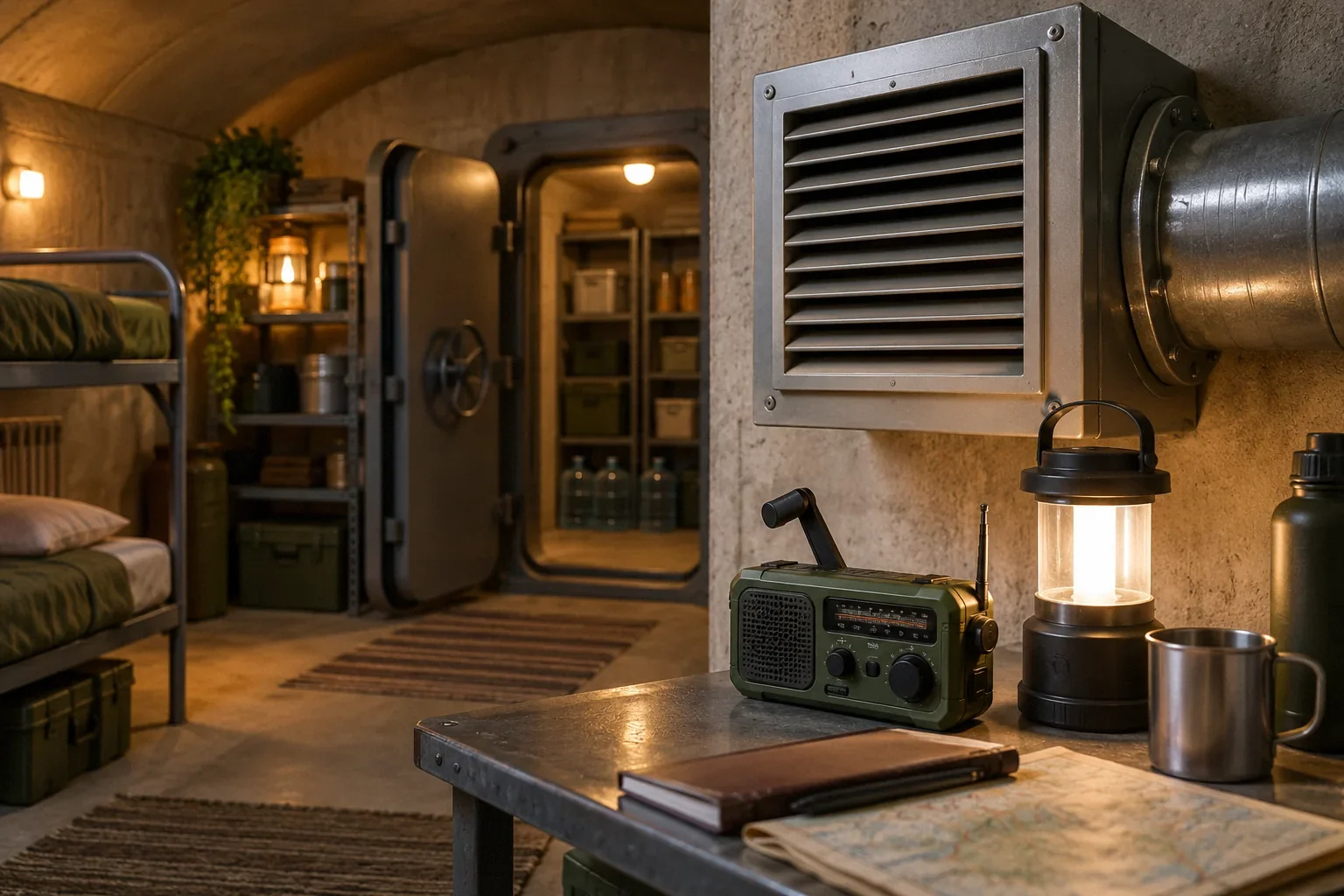
Ask the designer to describe each function in plain language and show where air is expected to travel. Include intake and discharge locations, any protective details at the enclosure and the equipment needed for each operating mode. The question is not whether an accessory sounds reassuring. It is whether the combined system addresses the identified occupants and hazard with evidence that can be checked after installation.
Connect air-system details to the shelter design
FEMA: FEMA P-361: Safe Rooms for Tornadoes and Hurricanes (April 2025) treats essential features as part of safe-room design and operation. Air openings and equipment cannot be coordinated entirely after the protective enclosure is built. Their location and construction may interact with the room's other performance requirements.
Request a coordinated design showing which components belong to the shelter system and how they are serviced. Identify any manufacturer instructions that control installation or maintenance. If a vendor proposes cutting a new opening through an already specified wall or roof, ask who approves that change. A hole that improves ordinary airflow may still conflict with another required feature. The responsible team should resolve those interfaces before a field installer improvises them.
Power loss needs a defined operating mode
List the air-system equipment that needs electricity and the conditions under which it must operate. Then ask what happens if utility power fails, a battery is depleted, a control fails or a required fan stops. A backup label is incomplete without the load assumptions, duration, maintenance and failure indication behind it.
Do not invent a manual workaround from a forum diagram. If a manual or passive mode is part of the design, it should have documented limits and an operating procedure the household can actually follow. Any commissioning demonstration should evaluate the intended system, not only confirm that a motor turns. Keep critical instructions accessible without relying solely on an internet connection or a powered screen.
Keep combustion hazards out of the shelter plan
CDC: Protect Yourself During a Power Outage warns against using generators and other gasoline-powered equipment inside a home, basement or garage and explains the danger of carbon monoxide. An open door or portable fan does not turn an occupied underground enclosure into a suitable generator location.
Plan the power source and its relationship to building openings with the appropriate professionals and instructions. Do not use candles or improvised combustion to create an air draft or test an atmosphere. An alarm is an additional protective measure, not permission to create the hazard. If an alarm sounds or occupants become unwell, follow emergency instructions and seek help rather than attempting to troubleshoot the system while remaining exposed.
Radon and an unknown atmosphere need separate attention
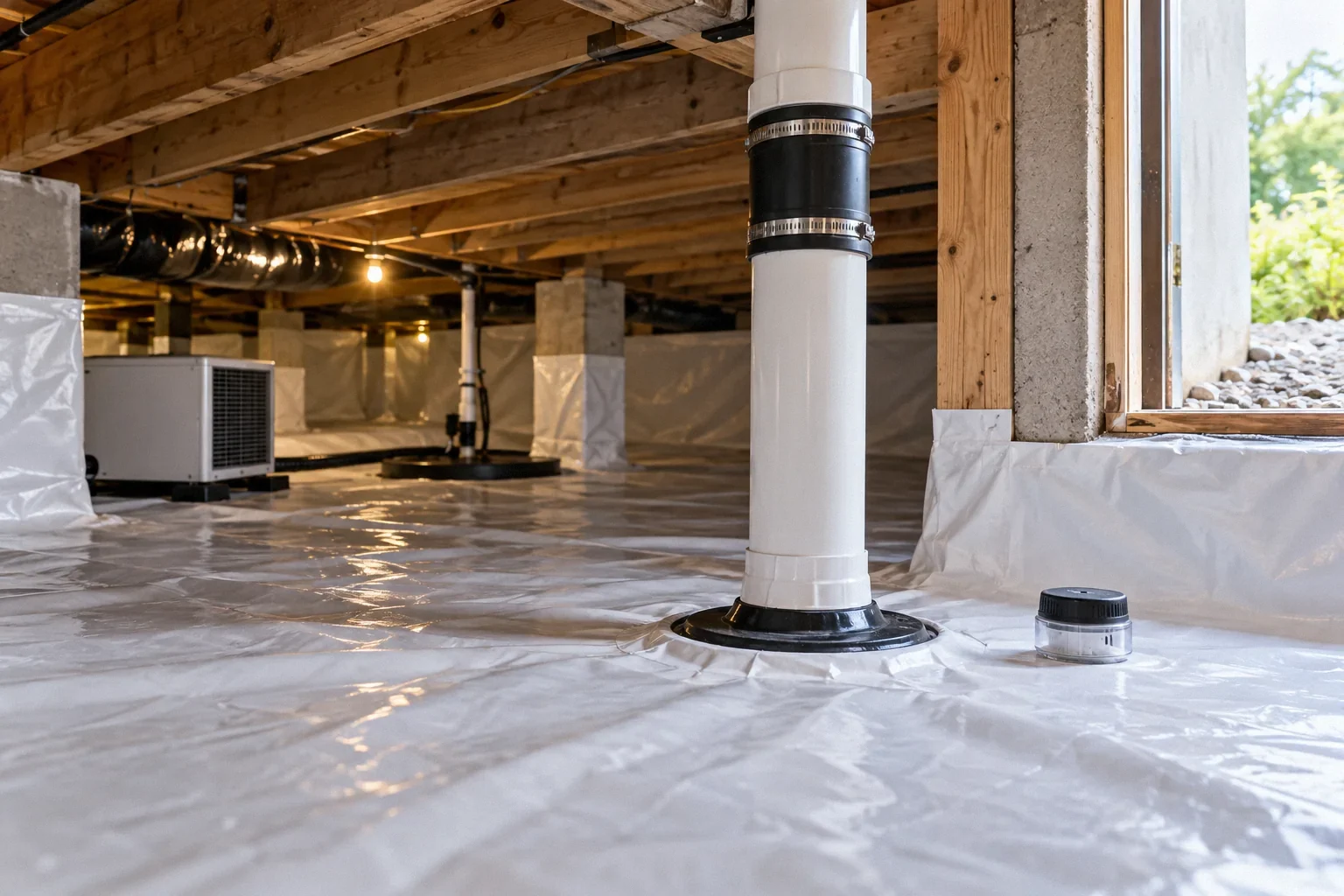
The EPA: Radon When Buying a Newly Built Home explains that radon-resistant construction still requires testing. A new ground membrane or ventilation accessory is not proof that indoor radon is acceptable. Discuss appropriate testing and any mitigation with qualified providers, especially where the project changes how a lower level is used.
An abandoned chamber raises a different immediate issue. OSHA: Confined Spaces: Overview identifies restricted entry and potential atmospheric hazards as features requiring careful assessment in workplace contexts. A consumer detector, lack of odor or a brief fan run does not establish that an unknown space is safe for entry. Do not enter to gather dimensions for a ventilation quote before appropriate professionals have assessed entry conditions. Finished occupancy design and safe construction entry are different tasks.
A hypothetical outage discussion with a vendor
Suppose a shelter proposal includes a powered fan and a battery but gives no occupancy assumption or operating duration. The homeowner asks whether the setup will support a family through a prolonged outage. The vendor answers that the battery is “large enough” without a documented load or performance basis.
The next step is a completed air-and-power design brief, not a bigger battery selected by the homeowner. Ask for the intended operating modes, equipment loads, maintenance and how a fault is indicated. The answer may change the equipment, intended use or product choice. This hypothetical highlights missing coordination; it does not calculate a safe occupancy time or recommend any particular fan, filter or battery arrangement.
Build a handover test and maintenance record
At closeout, obtain the system diagram, equipment identification, commissioning results, operating instructions and maintenance schedule. Ask what observations require service and who is qualified to make changes. Label controls in a way that household members understand, while preserving the approved operating procedure.
Keep spare parts and replacement filters consistent with the specified system. Test the planned power and communication arrangements in ordinary safe conditions according to the instructions. Do not assume that a filter substitution is harmless because it fits the opening; performance and resistance can differ. For an actual emergency, follow the applicable public instructions, which may depend on the hazard. A general shelter article cannot replace event-specific directions or a project-specific air design.
Before your next decision
- Define occupants, duration and intended hazard.
- Separate ventilation, filtration and moisture-control functions.
- Document power-loss and equipment-failure modes.
- Coordinate every opening with the enclosure design.
- Keep commissioning, testing and maintenance records.
Related questions
Does a dehumidifier supply fresh air?
Not by itself. Moisture removal and ventilation are different functions; the complete system must address each need that applies to the space.
Can I use a candle to make air move through a bunker?
Do not use combustion as a ventilation method or atmosphere test. Have an appropriate air system designed and keep combustion hazards out of the occupied space.
Does a filter make a shelter safe for every airborne hazard?
No. Filters have specific performance limits and do not establish whole-system suitability, adequate air exchange or protection against every contaminant.
Sources & further reading
- FEMAFEMA P-361: Safe Rooms for Tornadoes and Hurricanes (April 2025)
US guidance; distinguish local adoption and FEMA funding criteria
- CDCProtect Yourself During a Power Outage
US public health guidance
- OSHAConfined Spaces: Overview
US workplace rules/hazard recognition; not homeowner occupancy permission
- EPARadon When Buying a Newly Built Home
US radon guidance
Homeowner questions behind this article
These discussions informed the questions, not the technical answers. Some were available through indexed excerpts; votes and comments are not an engineering assessment.
- Ventilation system for underground bunker with no electricity?
- Ventilation for basement renovation
- Found bomb/fallout shelter in my basement in Portland update