The short answer
A crack in brick veneer does not, by itself, establish foundation settlement. The veneer, its support at openings, adjacent materials and the foundation can move or deteriorate for different reasons. Record the crack’s location and history, identify the wall assembly and compare related symptoms before deciding who should evaluate it. Repointing can close joints while leaving the reason they opened unresolved.
US general planning; California details labeled where relevant
Identify which masonry assembly you actually have
The word “brick wall” can describe a veneer supported and connected to another structural system or masonry that participates directly in carrying building loads. That distinction affects which support and connection questions matter. Appearance from the street may not establish the assembly, particularly where additions and alterations have changed an older building.
Start with drawings, construction history and an examination by someone qualified to identify the wall. The historical Residential Rehabilitation Inspection Guide discusses masonry observations as part of a broader building inspection. Use that context to avoid assuming that every brick crack has the same structural meaning. A useful report states the known assembly and any limitations, rather than quietly treating an assumption as a confirmed fact.
Map the crack relative to openings and supports
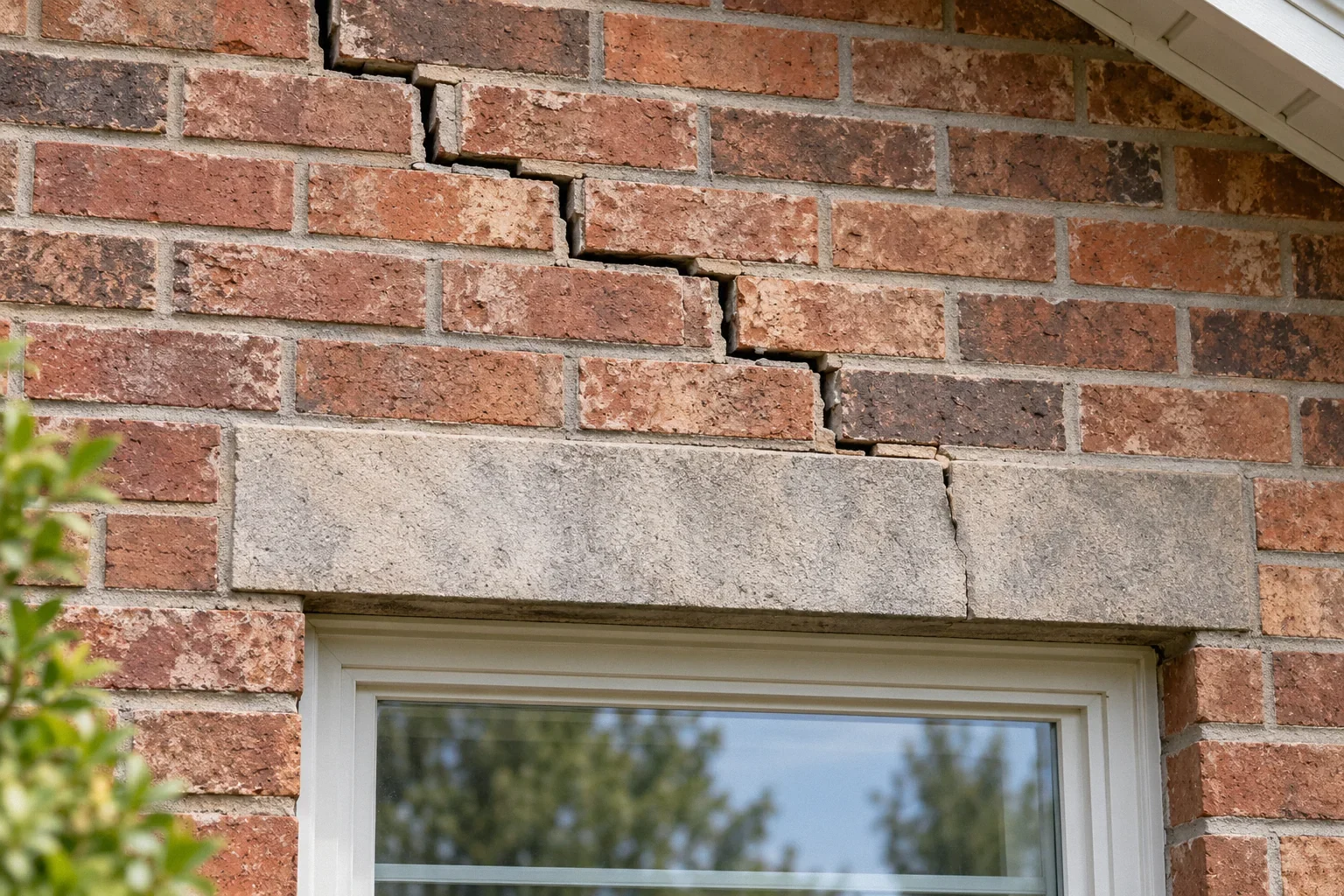
A crack beside a window, above a garage opening or near a change in wall height should be recorded in relation to that feature. A close photograph alone can conceal the clue that the crack begins at an opening or changes direction beside a material transition. Include a broad elevation view and a location drawing with the close detail.
At openings, the assessment may need to consider the lintel or other support carrying masonry above the gap, its condition and its relationship to surrounding materials. This is not a diagnosis that all cracks over windows come from lintels. It is a reason to ask about the local support before attributing every visible line to movement deep beneath the house.
Distinguish a pattern from proof of a cause
Stair-step cracks follow joints and are often discussed as settlement signs. They can be important evidence, but the pattern alone does not quantify movement or prove its origin. The wall’s geometry, support, materials, moisture exposure and history all contribute to interpretation. Similar-looking cracks in different assemblies may lead to different findings.
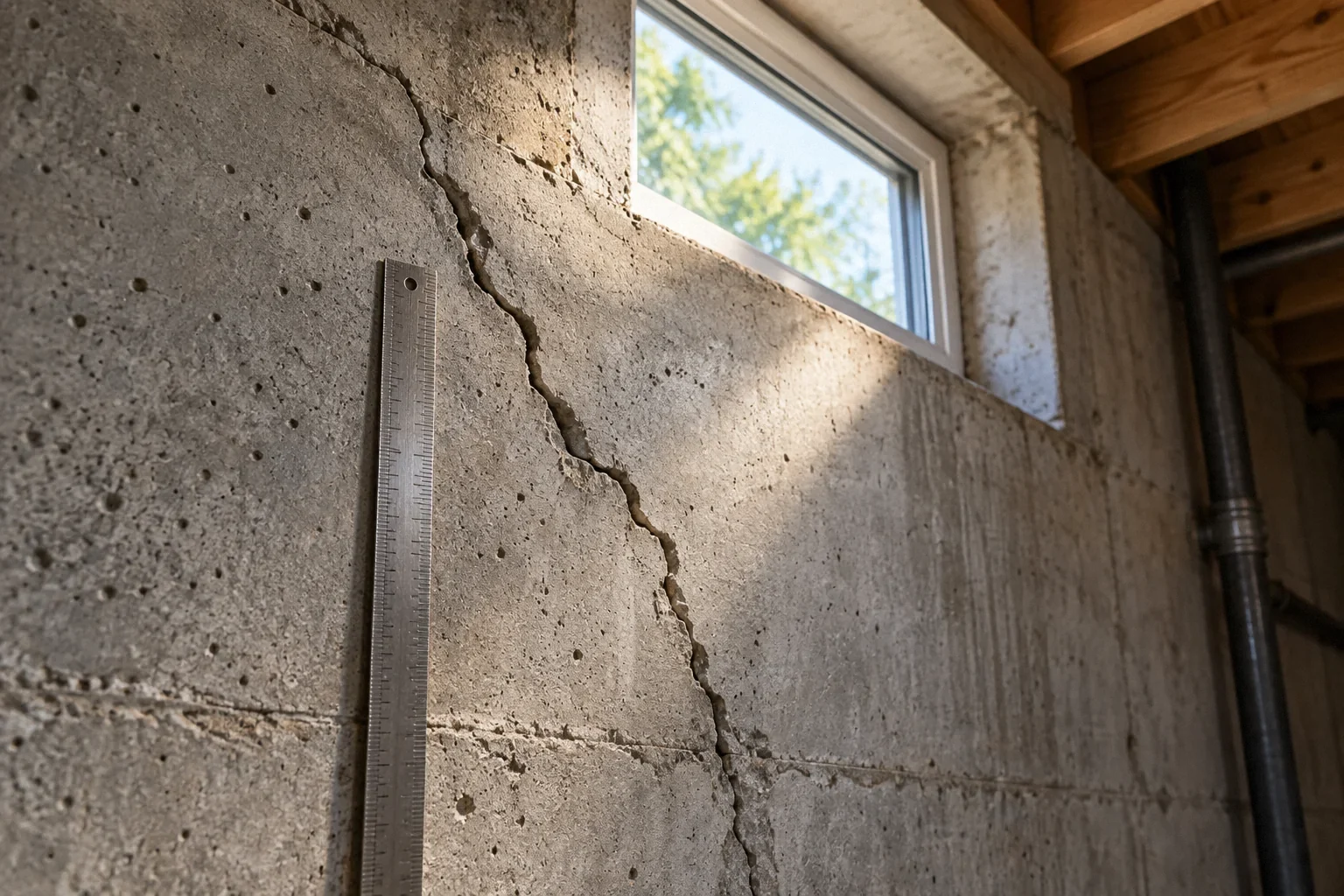
Concrete also responds to support, loading, moisture and temperature, as explained in CIP 4: Cracking Concrete Surfaces. That source is about concrete, not a diagnostic chart for brick veneer; its relevance is to the foundation portion of the assessment. If someone connects veneer cracking to concrete foundation movement, ask what independent evidence supports that connection rather than accepting a visual resemblance as the entire argument.
Compare independent symptoms across the building
Related evidence can include changes in door operation, interior finishes, exposed foundation surfaces and measured floor geometry. Record where each symptom occurs and whether their timing aligns. A sticking door on the opposite side of the house is not automatically corroboration, while several changing symptoms in the same area may justify a broader investigation.
Also record observations that do not fit the proposed explanation. An unchanged foundation survey or a defect concentrated at a corroded opening support may lead the assessor to reconsider an initial settlement theory. The purpose is not to collect as many alarming photographs as possible. It is to build a coherent history that can distinguish between competing causes.
Choose evaluation roles around the unanswered question
A masonry specialist can describe joint deterioration, units, local support details and repair options within their expertise. A structural engineer may be needed where load paths, support movement, significant displacement or uncertain wall behavior are involved. The useful division depends on the issue, not on which person happens to provide the first visit.
Ask each evaluator what their conclusion covers. “The mortar can be repaired” does not answer whether movement has stopped. “The foundation appears serviceable in accessible areas” may not address concealed veneer connections or a lintel. A clear scope helps the owner identify the remaining question without treating partial observations as contradictory diagnoses of the entire building.
A hypothetical crack above a wide window
Suppose a homeowner notices stepped cracking above a wide window and immediately seeks foundation piers. In this hypothetical case, an examination also identifies deterioration at the opening support, while the available foundation observations do not show corresponding movement. The next useful work is to resolve the local support question and its relationship to the masonry.
A different house might show similar veneer cracking together with changing floor elevations and new foundation distress below the same corner. That combination could justify investigation of ground and foundation behavior. The outward crack pattern has not changed, but the surrounding evidence has. This is why a photograph-based rule cannot reliably select the repair.
Do not let repointing erase the diagnostic baseline
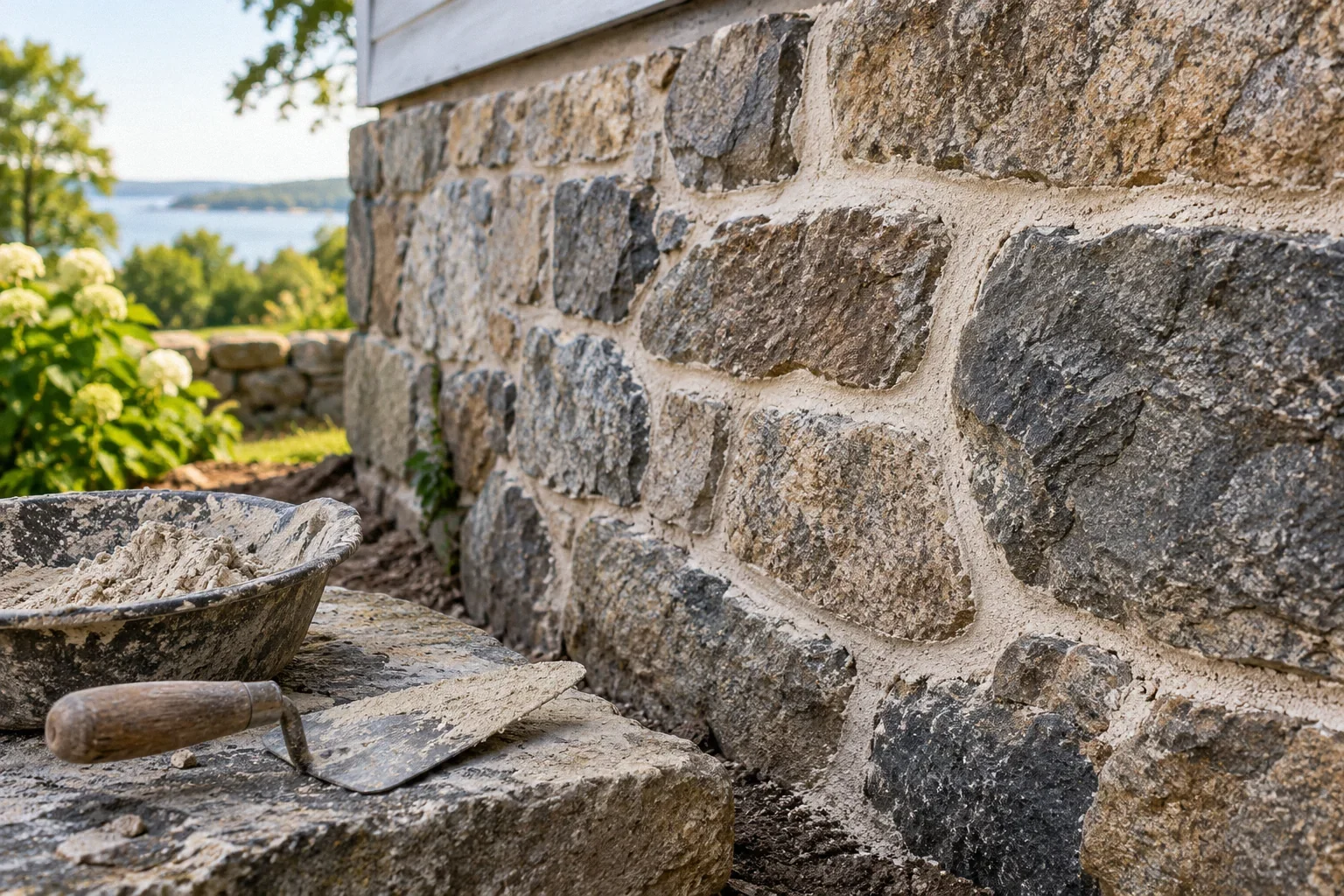
The NPS Preservation Brief 2: Repointing Mortar Joints in Historic Masonry Buildings explains that repointing should follow identification of deterioration causes and use compatible materials. The brief concerns historic masonry conservation; it does not settle the support design of a modern veneer wall. Its repair principle remains useful: replacing failed joint material should not be mistaken for correcting every cause of joint opening.
Before repair, save the crack map, photographs and relevant assessment. If monitoring has been recommended, clarify whether the proposed pointing would interfere with it. Where a repair proceeds, document which joints and units were treated. A later crack is easier to interpret when the owner can distinguish reopening at the same location from distress appearing in a previously unaffected area.
Ask for a conclusion that states both evidence and limits
A useful conclusion explains the most likely mechanism, the observations supporting it and the remaining uncertainties. It should separate a confirmed finding from a possibility requiring further work. If the recommendation is localized masonry repair, ask why broader movement is not currently the controlling concern. If foundation work is proposed, ask how it addresses the veneer symptoms.
The final decision should connect cause, scope and verification. Avoid relying on a promise that all cracks will disappear permanently after one intervention. Materials and connections remain exposed to changing conditions. A well-defined repair and observation plan is more credible when it states what it is intended to accomplish and what future changes would require renewed evaluation.
Before your next decision
- Identify the masonry assembly and known alterations.
- Photograph the full opening or elevation around the crack.
- Record timing and related symptoms in the same area.
- Ask what evidence links the crack to the proposed cause.
- Preserve a baseline before repointing or replacing units.
Related questions
Can veneer crack even if the foundation is stable?
Yes. Local support conditions, material behavior and masonry deterioration can produce cracks without demonstrated foundation settlement. The assembly and surrounding evidence determine which causes deserve investigation.
Does a stair-step crack prove settlement?
No. It is a useful pattern to document, but not a complete diagnosis. Location, timing, wall support and independent evidence of building movement are needed to interpret it.
Should a mason or an engineer inspect first?
Choose around the uncertainty. Local mortar deterioration may fit a masonry assessment; changing displacement, unclear support or possible building movement calls for appropriate structural evaluation, sometimes alongside masonry expertise.
Sources & further reading
- U.S. Department of Housing and Urban Development / National Institute of Building SciencesResidential Rehabilitation Inspection Guide
February 2000 guide; condition-assessment concepts only, not current code or a DIY repair specification.
- National Park ServicePreservation Brief 2: Repointing Mortar Joints in Historic Masonry Buildings
Historic masonry conservation; assessment and material compatibility, not a universal mortar recipe.
- National Ready Mixed Concrete AssociationCIP 4: Cracking Concrete Surfaces
Concrete crack mechanisms and prevention concepts; avoid universal safe-width claims.
Homeowner questions behind this article
These discussions informed the questions, not the technical answers. Some were available through indexed excerpts; votes and comments are not an engineering assessment.
- Hairline cracks in brick veneer between window sill and window well
- Crack in brick veneer
- Do I need to call a structural engineer? Noticing cracks in recently purchased home