The short answer
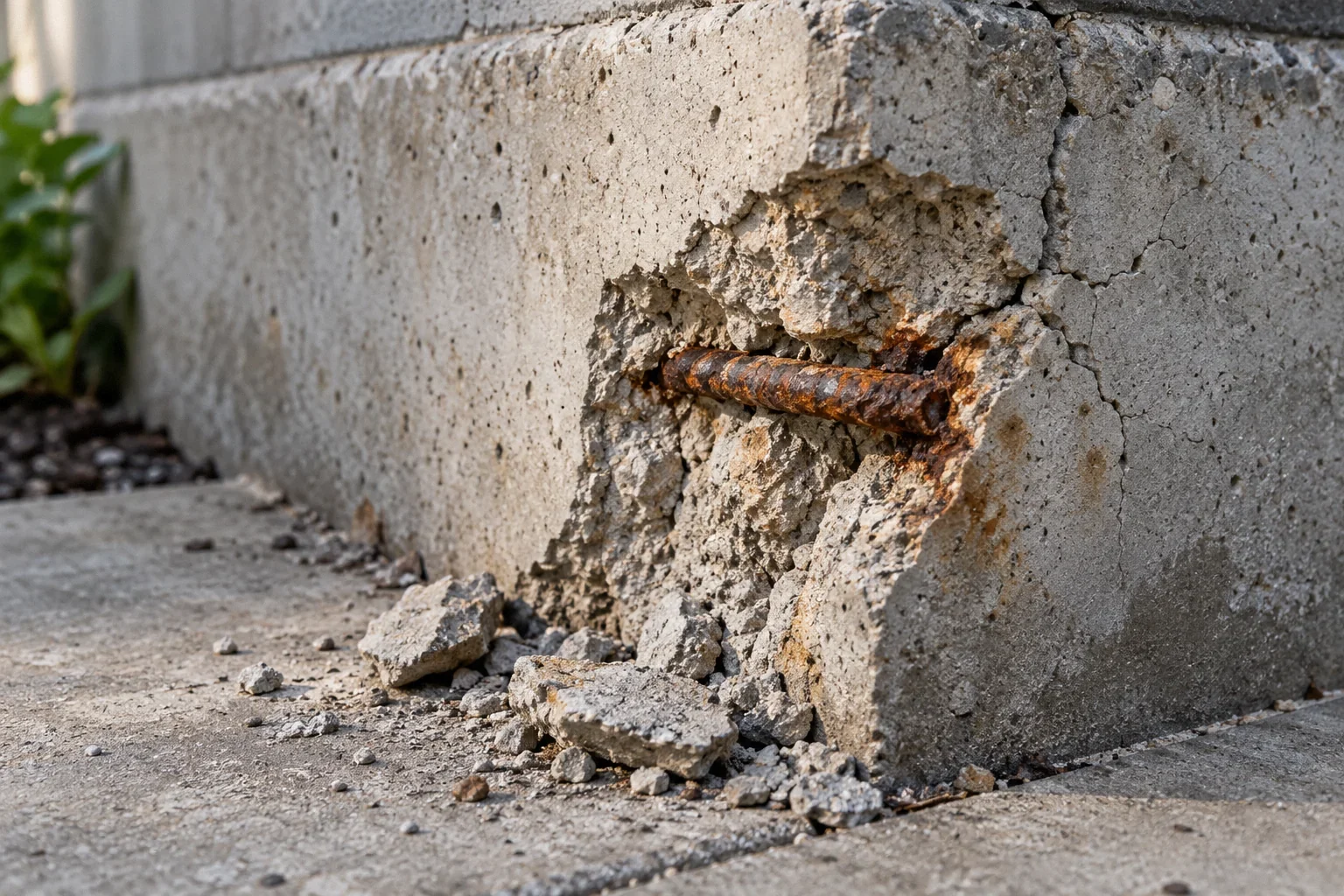
Spalling means concrete has broken away, but the visible missing piece does not establish the cause or full extent. Corroding reinforcement can expand and split its concrete cover while the steel itself loses section. Before patching, identify the affected component, investigate the deterioration and determine whether structural evaluation is needed. Exposed metal may require special precautions, particularly where post-tensioning could be present.
US general planning; California details labeled where relevant
Describe the missing concrete before naming a repair
Start with the location and pattern: a corner break, a strip along embedded steel, a hollow or separated surface, or an isolated damaged edge. Note when it was first observed and whether fragments continue to fall. These descriptions help distinguish a condition that was present after construction from one that has developed or spread during service.
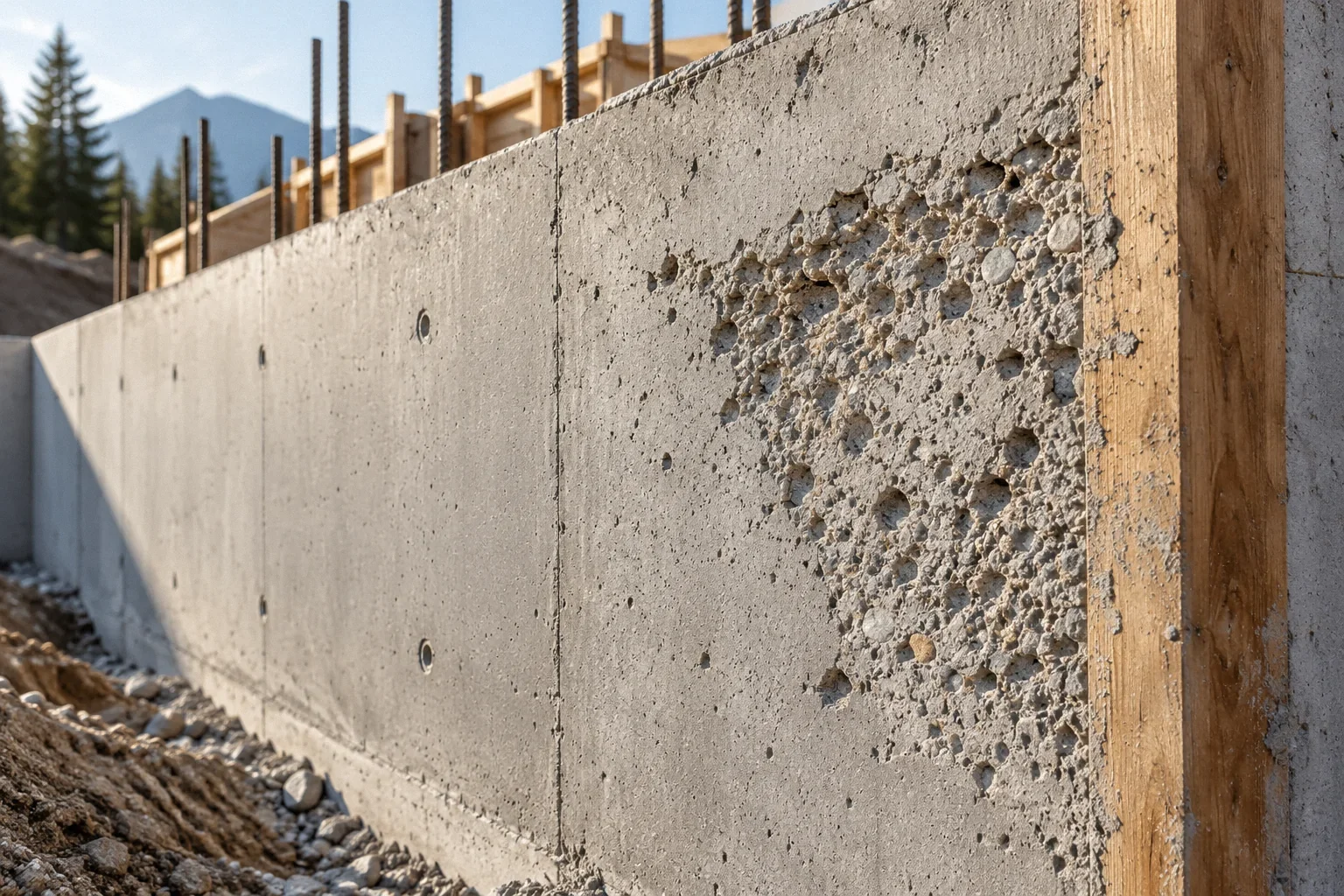
Avoid treating every rough surface as the same defect. Honeycombing from placement, mechanical damage and corrosion-related spalling can look similar in a photograph while requiring different responses. A useful assessment explains why a particular cause is plausible and what evidence would challenge it. “Needs a patch” describes an appearance, not a diagnosis of the concrete or steel beneath it.
Understand why rust can damage the surrounding concrete
Steel embedded in concrete benefits from a protective chemical environment, but conditions can undermine that protection. The CIP 25: Corrosion of Steel in Concrete explains how corrosion products occupy more volume and create pressure that can crack or separate concrete cover. The same process can reduce the steel’s remaining cross-section. Cover loss and steel loss are related concerns, not interchangeable measurements.
This is why a small visible opening may warrant examination beyond its outline. The opening can reveal a process extending along reinforcement, while apparently intact adjacent concrete may have separated beneath the surface. The appropriate extent of investigation depends on the component and symptoms. A homeowner photograph cannot establish the remaining capacity of an obscured reinforcing bar.
Identify the metal without disturbing it
Do not assume every exposed steel item is ordinary reinforcing bar. Foundations and slabs can contain anchors, reinforcement, conduits or post-tensioning components. Location, construction records and qualified examination are better ways to identify them than cutting, bending or striking the exposed item. Uncertainty about the component is itself useful information to give the assessor.
The PTI DC80.2-10 Guide for Creating Openings and Penetrations in Existing Slabs with Unbonded Post-Tensioning concerns openings and modifications in existing unbonded post-tensioned slabs and emphasizes a comprehensive assessment process. Its public abstract does not supply a safe cutting procedure. If post-tensioning may be present, make that uncertainty explicit before anyone proposes removal of surrounding concrete. A repair crew’s familiarity with ordinary patching does not answer questions about a different structural system.
Assess extent, cause and consequence as separate questions
The extent question asks how much concrete and steel are affected. The cause question asks what enabled the deterioration, such as exposure conditions or a defect that allowed aggressive substances to reach the steel. The consequence question asks how the affected region participates in supporting or connecting the building. Each can change the repair decision independently.
The Guide to Concrete Repair, 2015 treats concrete repair as a process of evaluating deterioration and selecting compatible treatment. Its professional guidance supports looking beyond the visible void, rather than covering the symptom with a convenient material. Ask how the proposed examination will distinguish localized damage from a broader mechanism. Also ask which findings would require the repair scope or structural review to change.
Why an ordinary surface patch may disappoint
A patch can restore a surface profile without addressing corrosion that continues behind it. It can also cover evidence needed to evaluate the steel. That does not mean all localized repairs are inappropriate; it means a repair should be selected for established conditions, including the substrate and reinforcement, rather than because the replacement material is available.
Compatibility includes more than compressive strength. The repair must fit the relevant exposure, bond requirements and dimensional behavior of the existing concrete. The responsible professional should explain the performance objective in language the owner can understand. A claim that the patch material is “stronger than the original” does not, by itself, establish that the repaired assembly will behave as intended.
A hypothetical spall beside a connection
Suppose an older raised house has a small area of broken concrete beside a sill anchor. A homeowner initially sees a cosmetic defect. In this hypothetical example, the assessor wants to know whether deterioration affects the concrete around the connection, whether the anchor is involved and whether adjacent material remains sound. The small surface area alone cannot answer those questions.
Compare that with an isolated chip on a nonstructural concrete edge after an impact. The same word, “spalling,” could be used casually for both conditions, yet the investigation and repair objectives differ. The value of assessment is to identify that distinction before an attractive patch makes both areas appear equivalent.
Request records that survive concealment
Before repair, retain photographs with a broad view and close views, the assessor’s description of the affected component and the observations supporting the proposed extent. If investigation reveals additional deterioration, the final record should capture that change. The record should make clear which exposed metal was identified and whether its condition affected the repair design.
After work, retain the repair specification, material information and any required inspection or test results. Do not substitute a single finished photograph for records of what was encountered. Future evaluation is much more reliable when the file distinguishes the original visible defect, the conditions found during professional preparation and the actual repair completed.
Follow the mechanism when deciding what to watch
Monitoring should reflect the diagnosed cause. Renewed cracking along the repaired area, rust staining, adjacent separation or recurring damage may be relevant, but their meaning depends on the exposure and structural context. Ask the assessor which changes merit attention and whether there is a planned review after repair. A generic promise to “keep an eye on it” leaves the owner without usable criteria.
Where falling concrete could injure someone or a structural connection appears compromised, obtain prompt professional evaluation and keep people away from the affected area as appropriate. Do not hammer the surface to determine how much will fall. Preserving evidence and avoiding disturbance are more useful than improvising a test on a component whose function remains uncertain.
Before your next decision
- Document the location before the area is covered.
- Identify exposed metal through records and qualified examination.
- Ask separately about extent, cause and structural consequence.
- Retain findings discovered during professional repair preparation.
- Use a monitoring plan tied to the diagnosed mechanism.
Related questions
Can I cover rusty reinforcement with ordinary mortar?
Covering it before assessment can hide ongoing deterioration and an unknown steel condition. The repair should address the identified cause, extent and component requirements; ordinary mortar is not a universal solution.
Does a little visible rust mean the bar has lost strength?
Surface appearance alone does not establish meaningful section loss or remaining capacity. The evaluation needs to identify the steel, determine its condition and consider its role in the structure.
Is every rough patch on a new foundation corrosion?
No. Placement defects, impact damage and other conditions can produce rough or missing concrete. The construction history, pattern and appropriate examination help distinguish these from corrosion-related deterioration.
Sources & further reading
- National Ready Mixed Concrete AssociationCIP 25: Corrosion of Steel in Concrete
Technical association guidance on reinforced concrete deterioration; no repair design or current code dimensions.
- U.S. Bureau of ReclamationGuide to Concrete Repair, 2015
Concrete repair principles from a water-infrastructure manual; no residential injection pressure, port layout or DIY procedure.
- Post-Tensioning InstitutePTI DC80.2-10 Guide for Creating Openings and Penetrations in Existing Slabs with Unbonded Post-Tensioning
Public abstract reviewed, not the complete purchased standard. Scope is unbonded PT slabs.
Homeowner questions behind this article
These discussions informed the questions, not the technical answers. Some were available through indexed excerpts; votes and comments are not an engineering assessment.
- Slab-on-grade foundation concrete spalling--How worried should I be?
- Cutting into Post-Tension Slab Tips
- 1921 PNW Foundation Concrete Honeycombing and Leaking Question