The short answer
New concrete can crack, but the fact that cracking is common does not classify a particular defect as acceptable. Honeycombing, exposed reinforcement, displacement and cracks near important connections need context. Record the condition before concealment, obtain the relevant construction information and ask the responsible design professional what examination is needed. A surface patch should follow a defined acceptance or repair decision, not substitute for one.
US general planning; California details labeled where relevant
Describe the observed defect without prejudging it
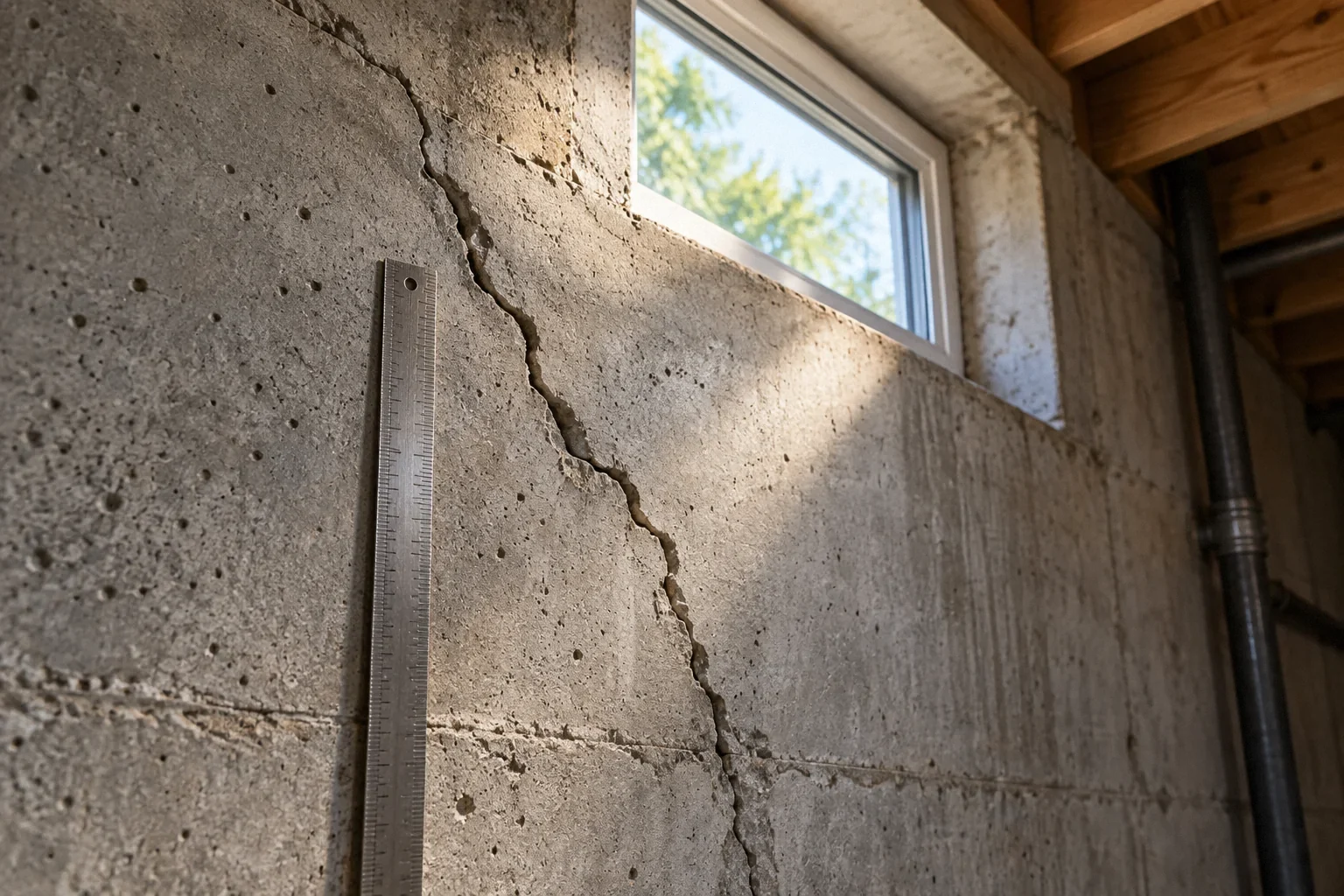
“Bad concrete” is too broad to guide an assessment. Describe whether you see a narrow crack, a displaced edge, a rough pocket with visible aggregate, missing cover, exposed metal or a change at a construction interface. Record the affected face, approximate extent and nearby supports or connections. Broad photographs show context that a close image cannot.
Likewise, “only cosmetic” should be a conclusion supported by the condition and its function, not a default response to a new owner’s concern. The useful first step is to preserve the observation and identify the question. Is the concern appearance, durability, continuity, reinforcement protection or support? Different questions can require different evidence even when the surface looks similar.
Understand common cracking without using it as an excuse
Concrete changes as it cures and as its moisture and temperature change. Support and loads also influence its behavior. CIP 4: Cracking Concrete Surfaces explains several mechanisms and the roles of construction practices, joints and reinforcement. Reinforcement can help control crack behavior; its presence does not mean that no crack can occur.
These principles help frame an investigation, but they cannot establish a universal harmless width for every new foundation. A crack’s location, direction, displacement, timing and relation to structural details matter. Ask the evaluator to explain which mechanism fits the observations and why that mechanism is compatible with the intended performance. A statement that “all concrete cracks” is background information, not an acceptance decision.
Treat honeycombing depth as an unanswered question
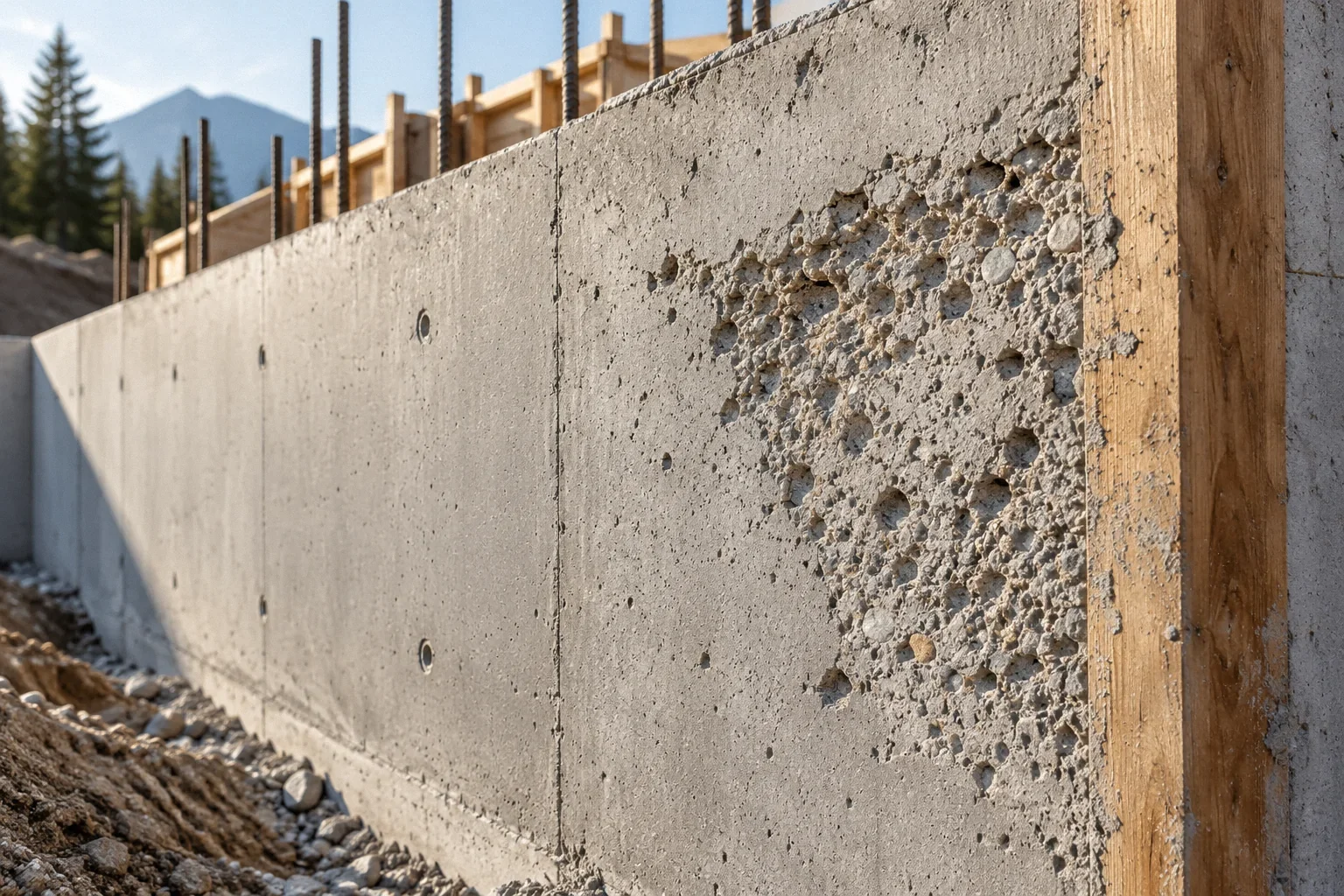
Honeycombing describes areas where the finished concrete contains visible voids or poorly consolidated aggregate. A photograph of the exposed surface cannot establish how far the condition extends into the member. The significance depends on the affected location, depth, surrounding concrete and relationship to reinforcement and load transfer.
Do not attempt to resolve that uncertainty by chiseling or drilling the area yourself. Ask the responsible professional whether visual examination is sufficient or whether a targeted investigation is necessary. The test or examination should answer a defined question. Ordering an impressive-sounding test without identifying the required information can produce data that do not settle whether the foundation is acceptable or needs repair.
Gather records that explain what was built
Useful records may include the relevant drawings, concrete placement information, available inspection records, reported test results and photographs taken before concealment. The exact documents depend on the project and the unresolved question. Request the records associated with the affected placement, rather than a generic certificate that may concern a different part of the work.
The historical Residential Rehabilitation Inspection Guide discusses concrete inspection and the possible role of professional testing within a broader rehabilitation assessment. It is not a current acceptance standard for new construction. Its practical lesson is to connect observations with appropriate evidence. A test result needs context: what material or location it represents, what property it measures and how that property relates to the observed defect.
Give reinforcement and connections their own attention
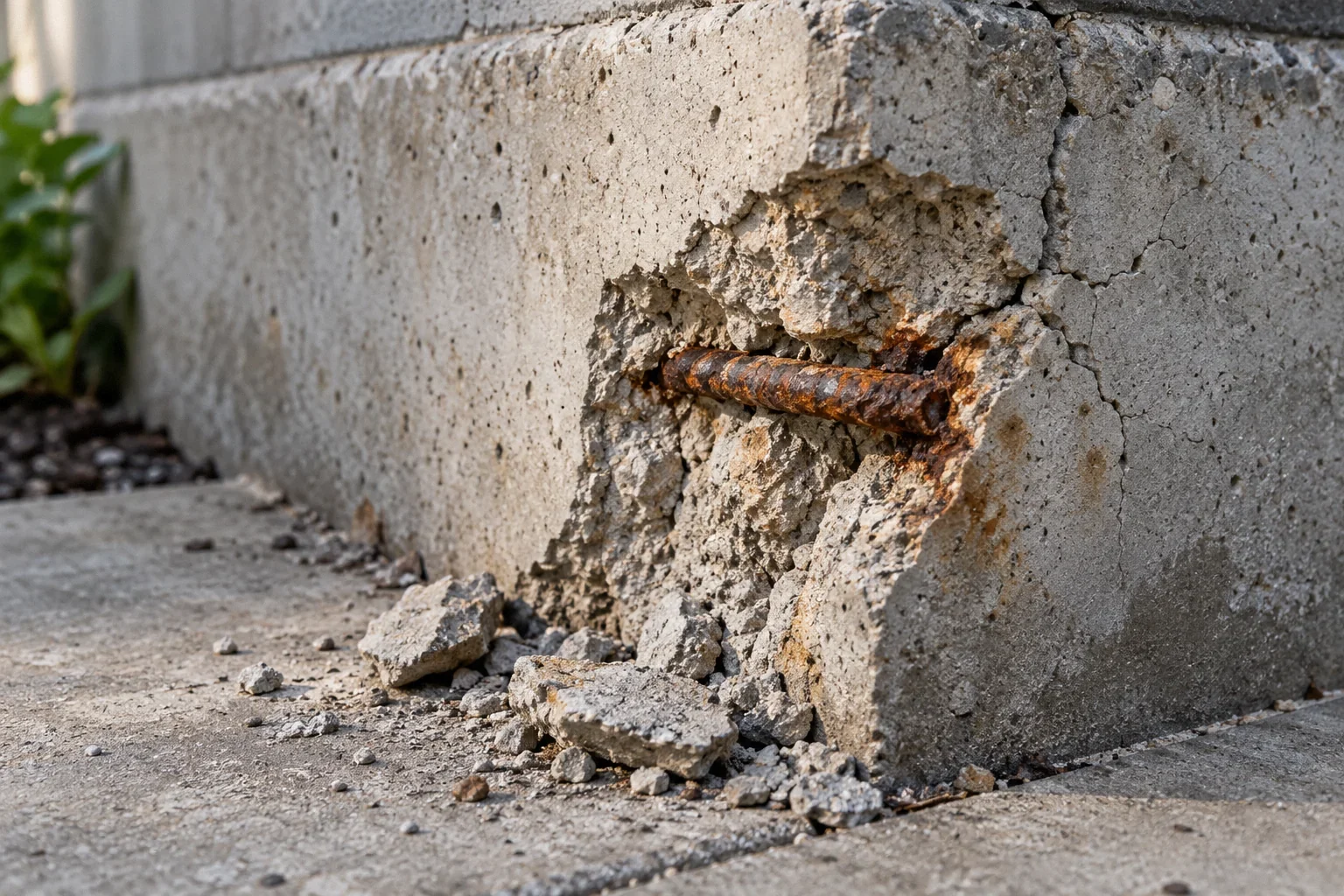
Concrete around reinforcement and anchors has more than a decorative role. Where metal is exposed or cover is missing, the assessment should identify the component and consider the implications for durability and the intended connection or member. Do not assume that visible metal is harmless construction debris or an ordinary bar without confirmation.
The corrosion mechanism described in CIP 25: Corrosion of Steel in Concrete explains why concrete protection of embedded steel matters over time. It does not mean every new exposed bar is already suffering significant corrosion. It supports asking whether the as-built condition and proposed repair provide the intended protection. That question is distinct from whether a patch can be made to match the adjacent surface.
A hypothetical defect before the wall is covered
Imagine a newly placed foundation wall with a rough pocket beneath a concentrated support location. The contractor proposes a quick patch before insulation and finishes proceed. In this hypothetical case, the owner asks for the defect to be mapped and the responsible professional to determine whether its depth and location require further evaluation.
That request does not presume the entire foundation must be replaced. It preserves the opportunity to distinguish a limited surface repair from a defect affecting performance. Once concealed, the same question becomes harder and potentially more disruptive to resolve. The valuable decision is whether the available evidence supports acceptance or a specified repair before access is lost.
Make repair selection follow the evaluation
The Guide to Concrete Repair, 2015 emphasizes diagnosing deterioration and selecting repair methods for the required function. Although the guide covers a broad range of concrete structures and repairs, its logic applies to a new-construction defect: the material and procedure should address an established condition. A generic filler does not establish that hidden voids, continuity or reinforcement protection have been resolved.
Ask the professional responsible for the repair to state its objective and the basis for completion. The record should distinguish preparation findings, specified treatment and any required verification. If the condition is accepted without repair, retain that determination and its reasoning. Both routes need a traceable decision; neither is strengthened by replacing the explanation with reassurance alone.
Keep the final condition linked to the original evidence
A final photograph is useful, but it should sit alongside the original location map and assessment. Record any change in the understood extent during evaluation or repair. If some areas were inaccessible or a test represented only a particular location, retain those limitations rather than describing the whole foundation as comprehensively tested.
After occupancy, use that baseline if a crack changes, a patch separates or a related symptom develops. The aim is not to expect failure. It is to make future observations interpretable. Clear records can prevent a later assessor from guessing whether an apparently new defect was present from construction, repaired at that time or first developed under a different set of conditions.
Before your next decision
- Map and photograph defects before finishes conceal them.
- Connect construction records to the affected placement.
- Ask what each proposed test will establish.
- Obtain a documented acceptance or repair decision.
- Retain original observations with final repair evidence.
Related questions
Is honeycombing cosmetic if the surrounding concrete feels hard?
Surface hardness does not establish the defect’s depth or effect on reinforcement and load transfer. The relevant professional should assess its location, extent and function before classifying it.
Does a passing concrete strength test settle every defect?
No. A result addresses the sampled material and test property. It may not establish consolidation, cover, continuity or the condition of a particular visible area in the finished foundation.
Should every new crack be injected?
No. Repair depends on the cause and required outcome. Some conditions may be accepted or observed; others need a specified repair. Injection should not replace the assessment that selects the response.
Sources & further reading
- National Ready Mixed Concrete AssociationCIP 4: Cracking Concrete Surfaces
Concrete crack mechanisms and prevention concepts; avoid universal safe-width claims.
- National Ready Mixed Concrete AssociationCIP 25: Corrosion of Steel in Concrete
Technical association guidance on reinforced concrete deterioration; no repair design or current code dimensions.
- U.S. Department of Housing and Urban Development / National Institute of Building SciencesResidential Rehabilitation Inspection Guide
February 2000 guide; condition-assessment concepts only, not current code or a DIY repair specification.
- U.S. Bureau of ReclamationGuide to Concrete Repair, 2015
Concrete repair principles from a water-infrastructure manual; no residential injection pressure, port layout or DIY procedure.
Homeowner questions behind this article
These discussions informed the questions, not the technical answers. Some were available through indexed excerpts; votes and comments are not an engineering assessment.
- New Construction home foundation
- 1921 PNW Foundation Concrete Honeycombing and Leaking Question
- Foundation diagonal crack in a house we’re considering—would you get a structural engineer?