The short answer
Repairing a slab leak stops one source of water, but it does not automatically establish that disturbed or eroded support beneath the building has been restored. If movement appears after a leak or plumbing excavation, document the timeline, repair route and backfill information. The plumbing findings and the structural or ground assessment should be considered together before choosing a slab or foundation repair.
US general planning; California details labeled where relevant
Keep the plumbing and support questions separate
A plumber may confirm that a leaking line has been repaired. That is a meaningful result, but it answers a plumbing question. It does not necessarily describe the condition of soil beneath a slab, the adequacy of backfill or the behavior of a nearby footing. Ask what was observed during the repair and what work was performed outside the pipe itself.
This distinction becomes especially important when the original leak was prolonged or excavation extended beneath a building element. Retain the plumber's photographs, route sketch and test results. They can help another professional understand the conditions encountered without relying on a later homeowner recollection that a large amount of material was removed.
Water can affect more than the visible surface
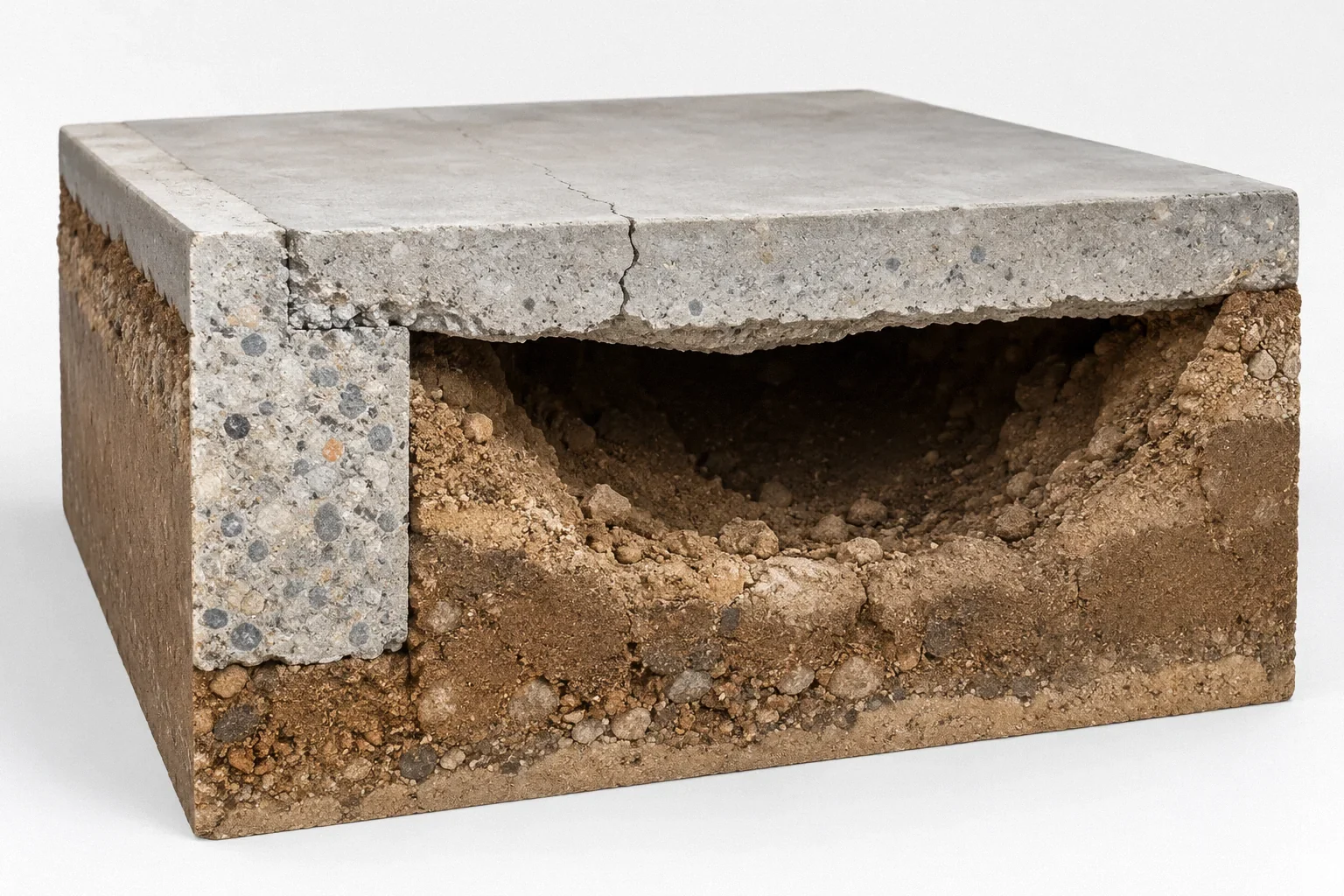
A leak may remain concealed while changing moisture around supporting soils. Depending on conditions, water can be relevant to erosion or changes in soil behavior. The HUD inspection guide includes leaking underground lines and water-related erosion among possible contributors to foundation movement in Residential Rehabilitation Inspection Guide. That is a reason to investigate the connection, not proof that a particular leak caused every symptom.
Some soils also respond to moisture changes by swelling or shrinking, as explained in the historical Colorado publication Home Construction on Shrinking and Swelling Soils, Special Publication 11. The direction of movement therefore should not be guessed from the presence of water alone. Record the actual building changes and let the investigation distinguish loss of support, soil-volume change and other possibilities.
Reconstruct the sequence with dates and locations
Make a timeline of the first leak indicators, diagnosis, excavation, pipe repair, backfill and later symptoms. Mark the known route on a floor or site plan. Include uncertainty: the date a crack was noticed may differ from the date it formed. Earlier photographs can help, but only if their locations and dates are clear.
Add any unrelated work occurring at the same time, such as removed porch posts or changed drainage. A sequence that seems obvious may contain several changes capable of affecting the structure. The goal is to preserve evidence before assigning blame or choosing a repair. A good timeline gives the assessor a way to test explanations rather than merely repeat the most recent event.
Find out what the excavation exposed and replaced
Useful records describe where excavation occurred, what supports were encountered and what material was placed afterward. Ask for existing photographs and documentation rather than excavating again yourself. A statement that the hole was filled does not explain the material, method or verification relevant to support.
FHWA discusses the importance of site characterization and foundation documentation in Acceptance Procedures for Structural Foundations of Transportation Structures, GEC 15. Its transportation guidance is not a residential backfill specification, but it illustrates why hidden conditions need records. For a house, the appropriate professional should evaluate whether the available information is sufficient. Where it is not, a targeted investigation may be needed, with a clear purpose and consideration of the risks of disturbing the area again.
Distinguish the slab from the building it may support
A patio slab, an interior floor and a thickened foundation element may have very different structural roles. If a porch roof post bears on the affected area, the investigation includes that load and connection. A sinking surface beside a house does not automatically mean the house footing has moved, and a seemingly minor slab defect can matter if a support relies on it.
Map posts, walls and beams alongside the plumbing route. Note changed gaps or alignment without tightening adjustable supports to erase the evidence. The repair decision should identify what has lost support and what carries load. Otherwise, an injection or leveling proposal may address the visible surface while leaving the more consequential question unanswered.
A hypothetical patio that moves after tunnel work
Imagine plumbing repairs require excavation beneath a patio near the house. Several weeks later, the patio drops and an attached roof connection changes. The owner assumes the entire foundation needs piers. An assessment must first determine how the patio and roof are supported, what was disturbed and whether the house foundation also changed.
The eventual response could differ substantially from a whole-house repair, but that cannot be decided from timing alone. Another hypothetical property might have a leak with no excavation and moisture-sensitive soil movement instead. These examples show why the investigation should follow the actual construction and records. Similar descriptions such as sinking after a leak can conceal different mechanisms and different repair targets.
Require the proposed repair to address the continuing cause
A support repair is incomplete as a plan if an ongoing water source or erosion path remains unexplained. Conversely, stopping water may be necessary without being sufficient where support has already been lost. Ask how the proposed work separates cause control from restoration of the affected structure or ground.
If filling a void is proposed, ask how its extent was established and how the result will be evaluated. If piers are proposed, ask which loads they will carry and how that relates to the observed damage. Avoid choosing a method simply because it can be performed through small openings. Access convenience is relevant, but it does not establish that the method addresses the documented problem.
Build two completion records instead of one ambiguous assurance
After a plumbing repair, ask for a record of the pipe work and a separate explanation of any ground or structural work associated with access. The first may establish the repaired service and testing appropriate to that trade. The second should explain what was disturbed, what conditions were found and how the affected support or backfill was addressed. One record does not automatically answer the other set of questions.
Location matters. A plumbing invoice naming a room may not show the route of a tunnel or the portion of ground that was exposed. Ask for drawings or photographs already produced during the work, with enough context to relate them to the house. This preserves information without inviting a homeowner to enter an excavation or investigate an unsupported space.
If new symptoms appear later, compare their timing and location with both records. A change after repair is a reason to investigate, not proof that the repair caused it. Conversely, successful leak testing should not be presented as evidence that every support condition is satisfactory. Separating the records keeps the follow-up focused: the plumber can address the service question, and the appropriate structural or geotechnical professional can evaluate any remaining support concern.
Preserve the record after the immediate repair
Keep plumbing completion information together with any structural observations, ground assessment and subsequent measurements. Record dates of floor or wall finish repairs so later changes can be interpreted. If monitoring is recommended, identify who reviews it and what would prompt earlier contact.
A dry floor or quiet water meter does not prove that every consequence of a leak is resolved. Equally, an old crack discovered during repair is not proof of continuing damage. The follow-up should focus on the specific conditions identified in the assessment. Clear documentation makes it possible to distinguish repaired plumbing, restored support and any remaining uncertainty, instead of combining all three into a single unsupported statement that the problem is fixed.
Before your next decision
- Retain the plumbing route, photographs and completion test records.
- Create a dated timeline distinguishing observation from assumed onset.
- Identify walls or posts that rely on the affected concrete.
- Ask how excavation and backfill were documented.
- Separate water-source correction from verification of restored support.
Related questions
Can support still need attention after the leak is repaired?
Yes. Plumbing repair and assessment of disturbed or eroded ground are separate questions. Whether additional work is needed depends on the actual findings.
Does settlement after tunneling prove the backfill was defective?
Timing is relevant but not conclusive. Construction details, records, other changes and the observed movement pattern need review before assigning a cause.
Should I tighten a sinking porch support myself?
Do not improvise an adjustment to hide or counter movement. A changed load-bearing support needs appropriate assessment of the structure and what supports it.
Sources & further reading
- U.S. Department of Housing and Urban Development / National Institute of Building SciencesResidential Rehabilitation Inspection Guide
February 2000 guide; condition-assessment concepts only, not current code or a DIY repair specification.
- Colorado Geological Survey / American Society of Civil EngineersHome Construction on Shrinking and Swelling Soils, Special Publication 11
October 1978 historical educational text. Use stable soil mechanisms only; exclude dated loss statistics, design dimensions and Colorado rules from California advice.
- Federal Highway AdministrationAcceptance Procedures for Structural Foundations of Transportation Structures, GEC 15
April 2022 transportation-foundation guide. Transferable concepts only; not residential prescriptive requirements.
Homeowner questions behind this article
These discussions informed the questions, not the technical answers. Some were available through indexed excerpts; votes and comments are not an engineering assessment.
Research method