The short answer
A tree near a foundation is not proof that it caused movement. Roots may interact with structures directly, while plant water uptake can also affect susceptible soils. Cutting roots or removing a tree changes the site and can create separate tree-stability concerns. Establish the likely mechanism first, using structural or geotechnical assessment and arborist input where needed, rather than treating removal as an automatic foundation repair.
US general planning; California details labeled where relevant
Three questions often get called root damage
The first question is whether roots physically contact or displace a building element. The second is whether vegetation affects moisture in soil that changes volume. The third is whether proposed cutting or excavation will make the tree unsafe. These questions overlap, but evidence for one does not automatically answer the others.
For example, a root lifting a walkway is not direct proof that it is lifting a house footing. A root exposed near a foundation does not establish how much water the tree removes beneath the building. A plan that protects concrete but undermines tree stability is incomplete. Describe the observed condition and keep these separate questions visible throughout the assessment.
Document the actual relationship to the building
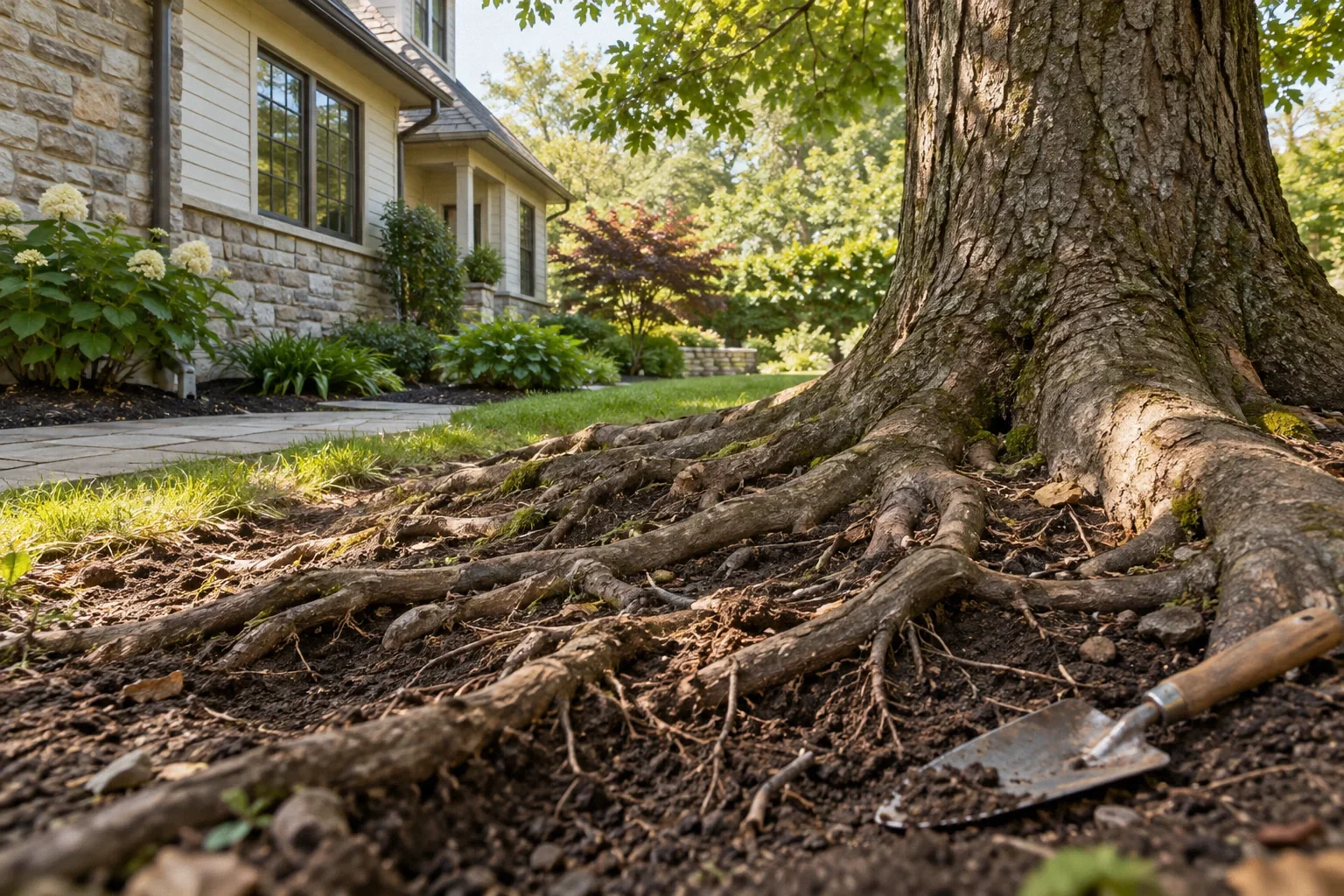
Photograph the tree, ground surface and affected structure together. Note whether the concern involves a detached path, porch, foundation wall or interior support. Record the approximate location on a site sketch without assuming that canopy spread defines every root location. Keep dates of pruning, irrigation changes and earlier repairs.
Avoid digging beside a footing to trace a root or cutting it to see whether the crack closes. The investigation itself can disturb support or injure the tree. If exposure is necessary, the relevant professionals should decide how it will be done. Existing observations and records may help define a targeted investigation before the ground is disturbed.
Understand the soil-moisture mechanism
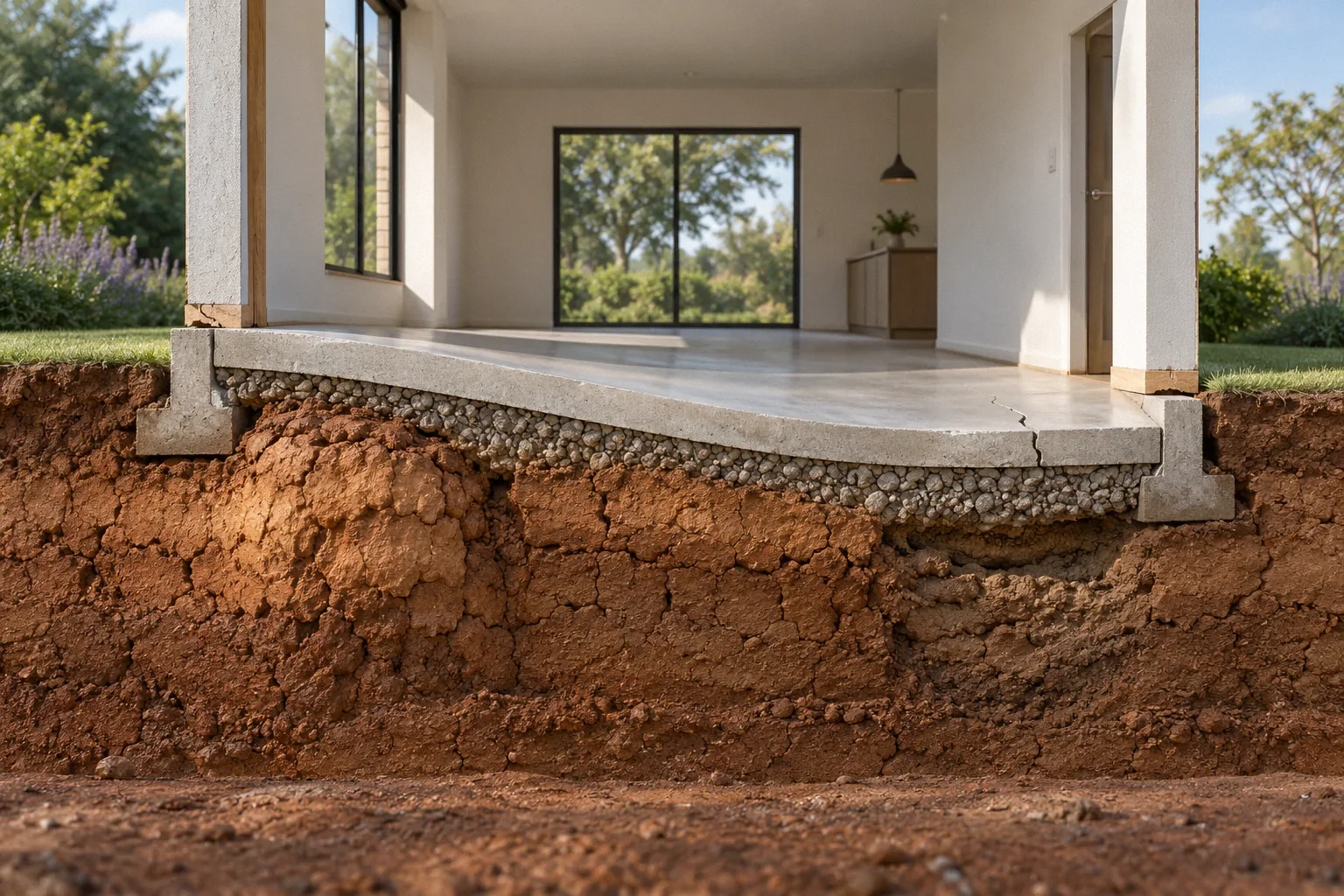
Plant water uptake can contribute to changes in moisture around some foundations. Whether that matters structurally depends on soil behavior and site conditions. The Colorado Geological Survey discusses vegetation, moisture variation and shrinking or swelling soils in Home Construction on Shrinking and Swelling Soils, Special Publication 11. It supports a possible mechanism, not a conclusion that every nearby tree causes settlement.
A regional clay label is insufficient to predict a particular result. The soil profile, moisture history, foundations and other water sources matter. If a tree is blamed for movement, ask what evidence connects its influence to the observed pattern. Also ask whether leaking pipes, runoff or changes in irrigation offer competing explanations. A plausible story becomes more useful when those alternatives have been considered.
Removing the tree changes conditions, not just the view
Removal can change water uptake and the physical conditions around the roots. That is why it should not be presented as a guaranteed way to stop foundation movement. Where moisture-sensitive ground is involved, the likely response needs site-specific assessment. Do not infer a safe removal sequence or time interval from a generalized online discussion.
The decision may also involve tree health, protection rules and the owner's landscape goals. Those are legitimate considerations, but they should be distinguished from a claim about structural benefit. If removal is proposed to address a building problem, ask who is evaluating the expected ground response and how the house will be observed afterward. The reason for the action should remain explicit.
Root cutting can create a tree hazard
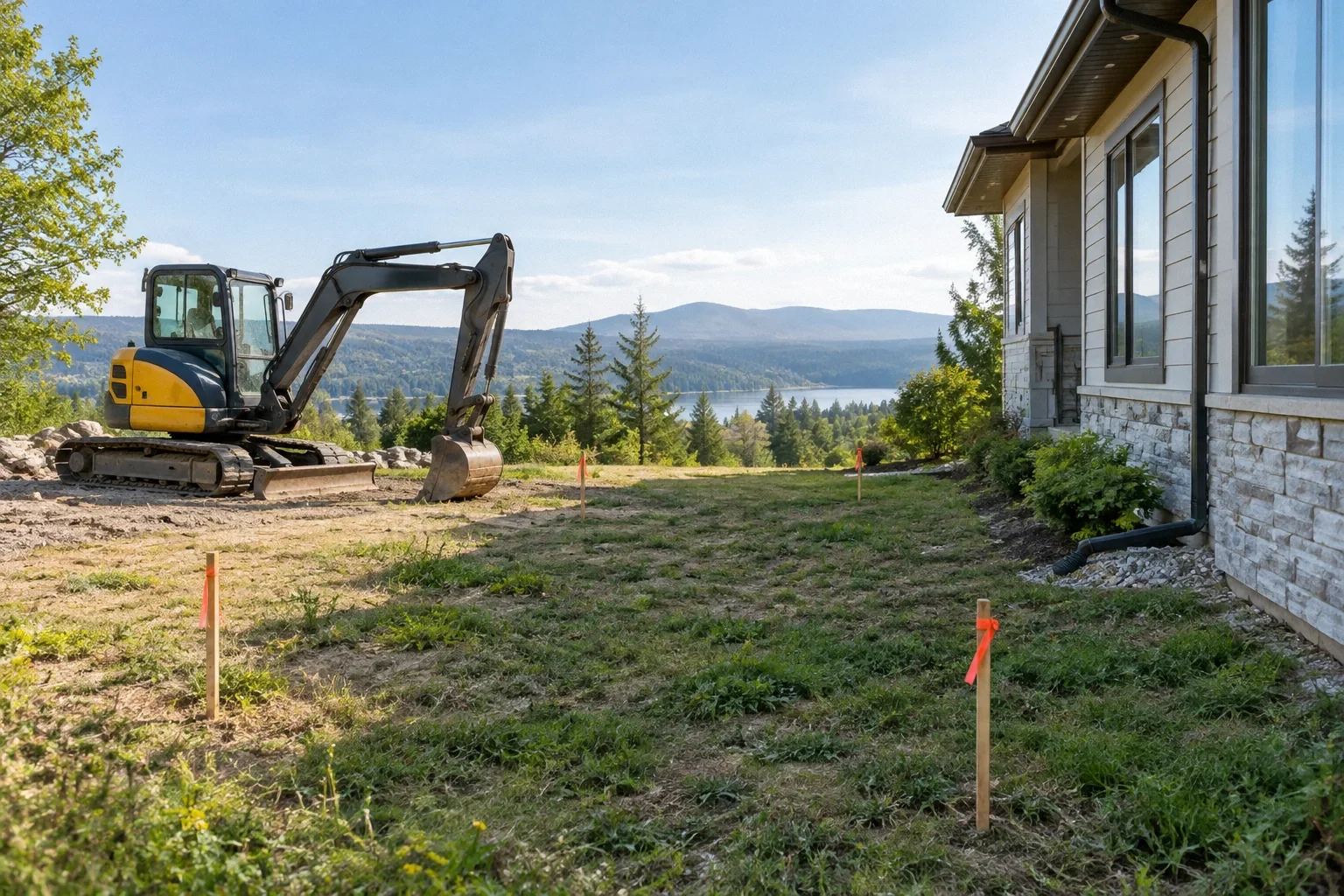
University of California guidance explains that cutting or injuring large roots can increase vulnerability to windthrow, and that compaction or grade changes can harm roots, in Protecting Trees During Construction. This means a trench or foundation repair near a tree should be coordinated before equipment arrives.
An arborist can evaluate tree-related constraints and help the project team understand what proposed work may affect. Structural and geotechnical professionals address different aspects of the building and ground. The useful result is a coordinated plan, not competing instructions issued independently. Do not let a repair crew treat a substantial root as an incidental obstruction without checking the consequences for the tree and the people or structures around it.
A hypothetical root discovery under a porch
Imagine a homeowner finds a root beside a tilted porch slab and concludes that a tree must be removed to protect the entire house. A later assessment identifies the porch as a separate assembly and finds a drainage defect nearby. The root may still matter, but the initial conclusion extended beyond the available evidence.
Now imagine a different house with documented seasonal movement, relevant soil information and a moisture pattern requiring further investigation. Arborist and ground expertise may be needed together. These hypothetical examples do not establish what should happen to either tree. They demonstrate why the object being moved, the mechanism and the extent of the affected area should be identified before a permanent landscape decision is made.
Ask what evidence supports each proposed action
A proposal might involve changing drainage, protecting roots during construction, further investigation or removing an unhealthy tree. Ask which problem each measure addresses. If the claimed benefit is foundation stabilization, request the reasoning connecting that action to the building condition.
The historical HUD guide lists vegetation-related moisture changes among possible contributors to foundation movement in Residential Rehabilitation Inspection Guide. It also discusses other causes, reinforcing the need for a broader assessment. Do not treat a root photograph as the equivalent of a geotechnical finding. Equally, do not dismiss direct contact or visible displacement merely because roots are common around houses. The question is what the evidence shows at this location and what intervention it supports.
Compare the consequences of keeping, pruning and removing the tree
A tree decision should address both the building concern and the tree’s condition. Ask what evidence supports the proposed action, what change it is expected to produce and what uncertainty remains afterward. Pruning roots, altering irrigation and removing the tree are different interventions; they should not be treated as interchangeable ways to “get roots away from the house.”
The arborist can address tree health and stability, while the foundation or geotechnical assessor considers the identified structural and ground mechanism. Where the recommendations interact, ask the professionals to reconcile them. A tree specialist’s conclusion that a root can be managed does not independently establish that the foundation problem will stop, just as a foundation concern does not establish how the tree will respond to a particular intervention.
Also consider what evidence should be retained before the tree or landscaping changes. Photographs of locations, known water sources and the affected foundation area help later reviewers interpret subsequent observations. If monitoring is part of the recommendation, clarify what it tests and over what relevant conditions. Removing a tree changes the site history; it should not erase the original question or create an automatic assumption that any later movement has the same cause.
Keep the follow-up focused and measurable
If work proceeds, retain the original observations, professional recommendations and dates of changes. Record any related irrigation or drainage work, because several simultaneous changes can make later interpretation difficult. Ask whether building observations, tree inspections or both should continue.
Avoid describing a successful tree removal as proof that the foundation problem is resolved before the relevant outcome has been evaluated. A healthy remaining tree, a repaired walkway and a stable house are different results. Clear follow-up protects the value of the original investigation and helps future professionals understand what was changed. It also makes the owner's decision more defensible than a vague record stating only that roots were found and the tree was taken out.
Before your next decision
- Identify the affected element, not just the nearest tree.
- Record water sources, movement history and prior landscape changes.
- Keep direct root contact separate from soil-moisture hypotheses.
- Coordinate arborist and building expertise before root disturbance.
- Document the intended outcome and follow-up after any intervention.
Related questions
Will removing a tree stop foundation movement?
Not necessarily. The cause must be established, and removal changes site moisture and root conditions. Its structural benefit cannot be assumed from proximity alone.
Can I cut one large root beside the house?
Do not treat that as a routine experiment. Root cutting can affect tree stability and should be considered with arborist input and the needs of the foundation work.
Is there a universal safe planting distance?
No single distance resolves all combinations of tree species, soil, foundation and site geometry. Use appropriate local landscape and building guidance for the particular situation.
Sources & further reading
- University of California Statewide IPM ProgramProtecting Trees During Construction
Tree stability and construction interaction. Does not establish a universal tree-to-foundation distance or diagnose subsidence.
- Colorado Geological Survey / American Society of Civil EngineersHome Construction on Shrinking and Swelling Soils, Special Publication 11
October 1978 historical educational text. Use stable soil mechanisms only; exclude dated loss statistics, design dimensions and Colorado rules from California advice.
- U.S. Department of Housing and Urban Development / National Institute of Building SciencesResidential Rehabilitation Inspection Guide
February 2000 guide; condition-assessment concepts only, not current code or a DIY repair specification.
Homeowner questions behind this article
These discussions informed the questions, not the technical answers. Some were available through indexed excerpts; votes and comments are not an engineering assessment.
- Will this tree cause heave if removed?
- Was quoted 100k for foundation repair (30+ helical piers) by a foundation repair company. Should I run this by a structural engineer first?