The short answer
Watering a foundation usually means managing moisture in nearby soil, not wetting the concrete itself. That practice is relevant to some expansive-soil settings, but it is not a universal home-maintenance rule. A soil gap during drought does not establish foundation damage, and adding water without understanding drainage can create other problems. Base changes on local soil behavior and the conditions around the particular house.
US general planning; California details labeled where relevant
Why homeowners receive opposite advice
Owners in some clay-soil regions discuss irrigation as routine foundation care, while owners elsewhere are told to keep water away from the house. The apparent contradiction comes from compressing different goals into short slogans. Limiting abrupt soil-moisture changes is one question. Preventing roof runoff or irrigation from saturating vulnerable areas is another.
The useful response is not to choose whichever slogan has more supporters. Identify the foundation type, soil information and existing drainage. Then ask what problem a proposed watering practice is supposed to prevent. A recommendation made for a neighboring region, or even a different lot, may rely on conditions that have not been established at your property.
What expansive soil does and does not mean
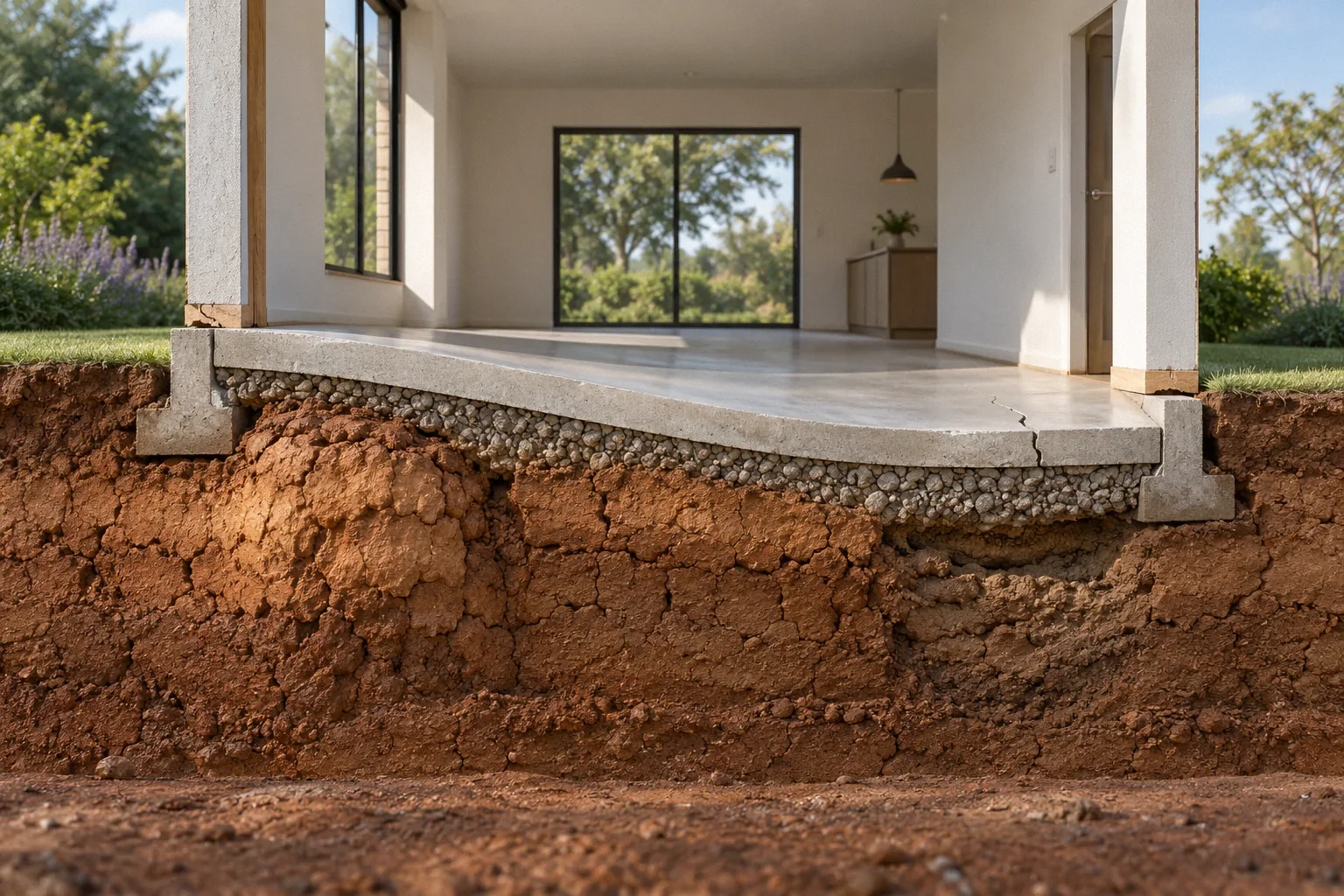
Certain clay minerals can change volume with changes in moisture. The Colorado Geological Survey explains the influence of mineralogy, soil condition and nonuniform wetting in Home Construction on Shrinking and Swelling Soils, Special Publication 11. This is a historical educational source about mechanisms, not a current irrigation schedule or a prediction of damage for a California house.
A yard described as clay may contain different layers, disturbed fill and areas covered by paving. The foundation's depth and arrangement also matter. USDA soil surveys can help identify potential limitations and characteristics, as described in Soil Surveys Can Help You, but planning maps do not replace property-specific information. Ask whether the expansive-soil concern comes from an actual report, a map or simply local reputation.
A gap beside the house is an observation
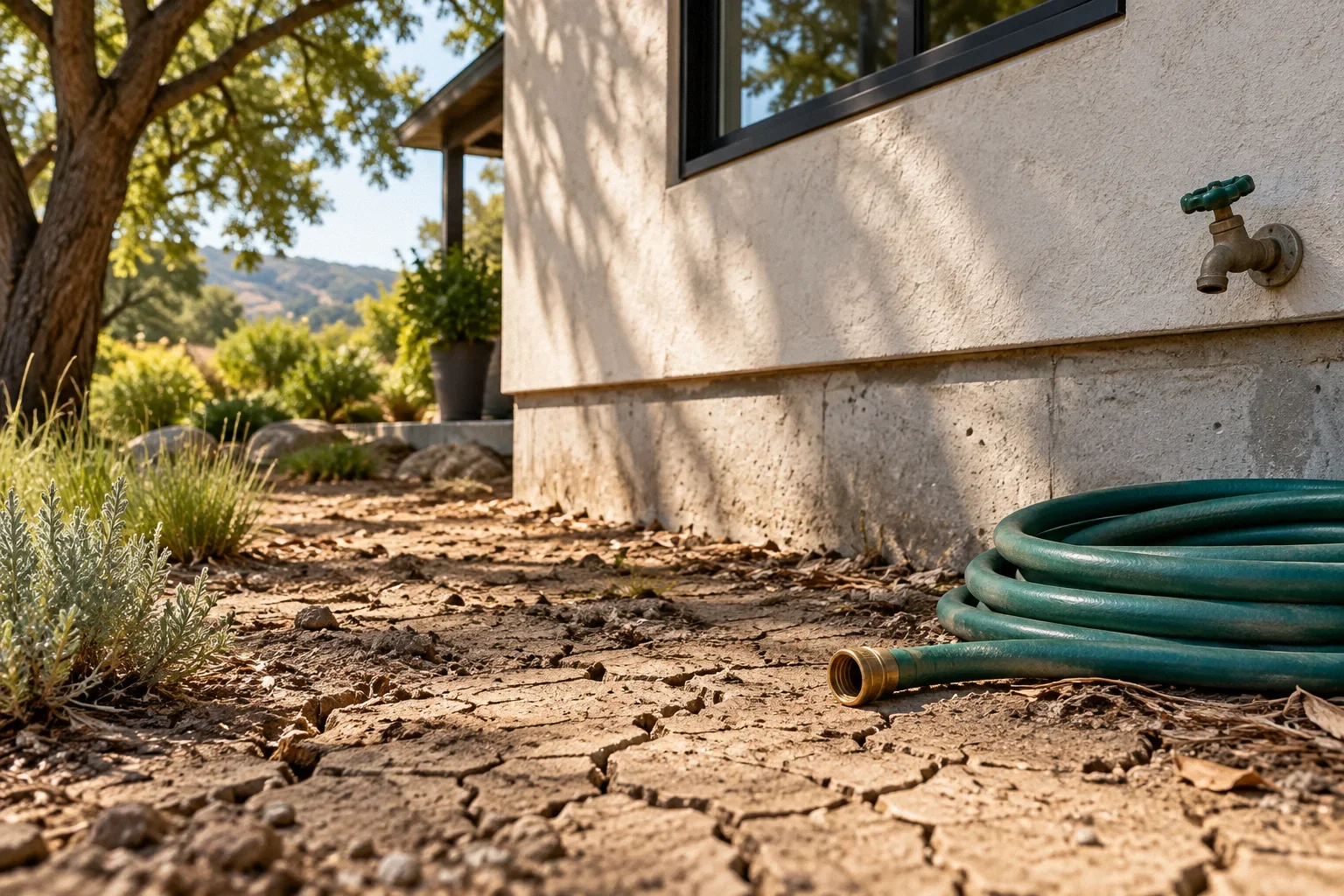
Dry soil may pull away from a foundation or develop surface cracks. Photograph the condition and note its location and timing. Do not convert it directly into an estimate of how far the house has moved. Surface soil and deeper bearing conditions are not interchangeable, and the building may have no documented change at all.
Look for related observations without using them as a homemade diagnosis. Have doors begun sticking? Are there new displaced cracks? Are the symptoms on the same side as a known leak or irrigation change? Record when each was noticed. A useful assessment distinguishes a drought-related surface condition from evidence that support or the structure itself has changed.
Consistency is different from saturation
A plan intended to moderate soil-moisture variation should not be confused with keeping the footing wet. Water concentrated beside one wall can behave differently from moisture elsewhere around the house. Low areas, poorly drained planting beds and leaking irrigation lines may make a simple watering instruction inappropriate.
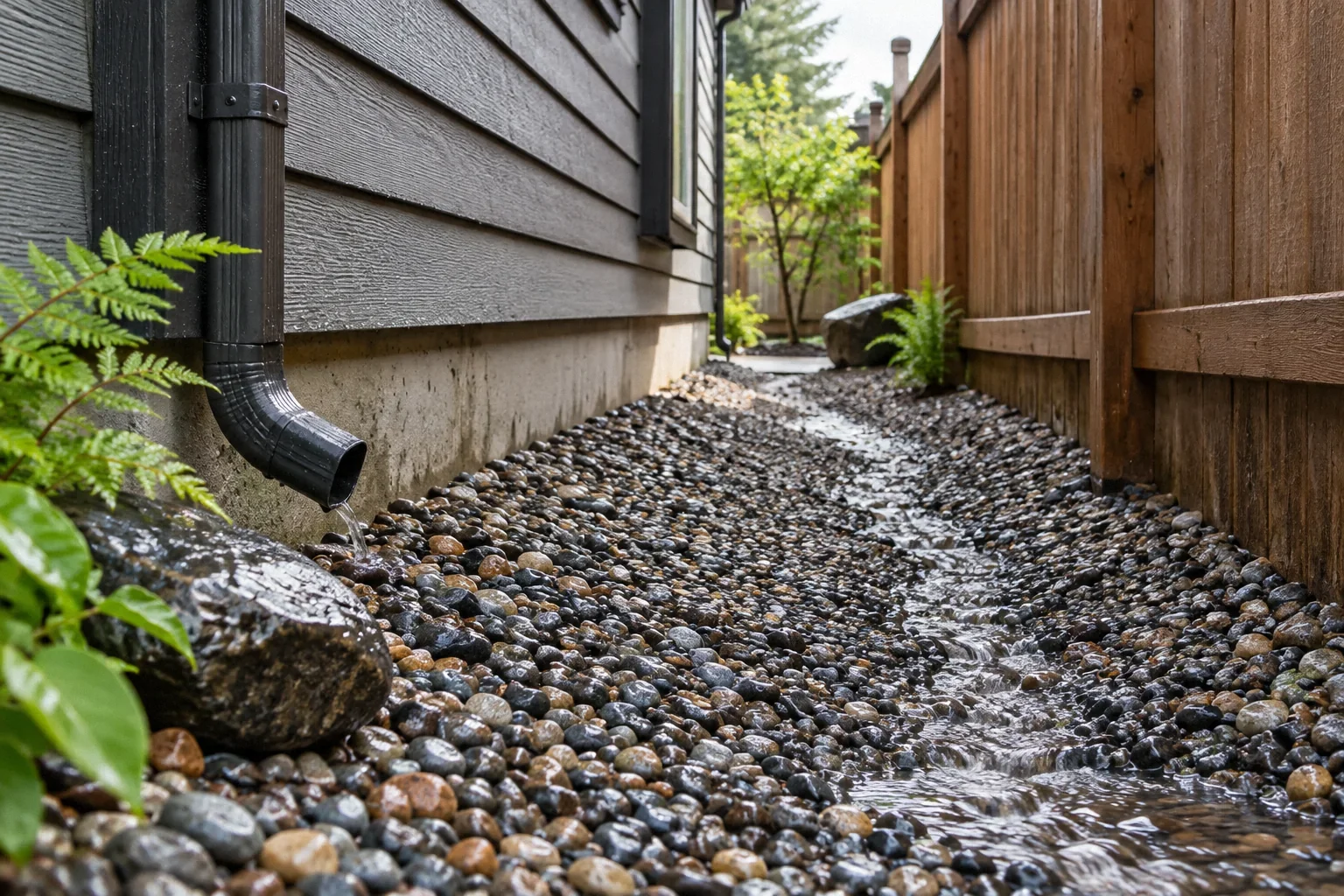
DOE describes how roof water can saturate soil around a building in Foundation Drain Gutters Downspouts. That drainage concern remains relevant even where expansive soils exist. The question is how to manage water across the site, with an understanding of both excess water and drying. Avoid an experiment that deliberately floods a dry gap or concentrates irrigation at the lowest-looking corner in an attempt to lift the house.
Map all the sources of water first
Draw the roof drainage outlets, irrigated beds, paved areas and known buried lines. Observe where runoff travels during rain and where wet areas persist after irrigation. A downspout that empties into a planting bed may dominate the moisture pattern regardless of what a soaker hose is doing. Conversely, a failed irrigation zone may leave only part of the perimeter dry.
DOE's grading guidance emphasizes directing surface water away from the house in Land is Graded: Final Grade Slopes Away from Foundation. That general principle does not determine the complete design for every clay site. It does show why water management needs a route and an outlet. A recommendation should address how the proposed practice interacts with drainage, rather than treating irrigation and runoff as unrelated maintenance tasks.
A hypothetical mistake in copying a schedule
Imagine an owner copies a relative's summer watering routine. The relative has exposed soil around most of the house, while the owner's house has paving along one side and a low planting bed along another. The same timer setting does not create the same moisture conditions. Water may accumulate in the bed while another area remains comparatively dry.
Now imagine the owner first identifies a leaking valve and an obstructed downspout outlet. Correcting those defects may change the question before any new irrigation is considered. The example is hypothetical and does not prescribe a sequence for a particular house. It illustrates why a transferable schedule is a poor substitute for understanding the site's actual water sources and pathways.
Ask for a site-specific moisture objective
If a professional recommends moisture management, ask what conditions the recommendation is intended to maintain and how the owner should observe them. Clarify how existing irrigation, rainfall, vegetation and drainage affect the plan. A useful explanation should identify limitations and situations that require reassessment, rather than promise that watering prevents every foundation problem.
Also distinguish maintenance from repair. A change in irrigation does not automatically correct a damaged connection, failed pipe or lost support. If movement has been documented, the assessment should address that condition directly. Keep the recommendation with any soil report and baseline observations so future changes can be evaluated against the reasoning that originally supported the plan.
Ask what condition would make the moisture plan change
A useful moisture-management discussion includes exceptions. Ask what to do if a previously dry area becomes persistently wet, a pipe leaks, runoff concentrates beside the house or local watering restrictions change. A fixed instruction detached from those conditions can continue long after its original assumptions no longer apply. The person advising the plan should explain the objective and the circumstances requiring review.
Separate plant irrigation from an assumed structural treatment. A landscape schedule may be designed to keep particular plants healthy, while a foundation recommendation concerns the behavior of specific ground conditions. Those purposes can interact without being identical. Coordinate the discussion so that a change intended for one purpose does not silently undermine the assumptions used for the other.
Also ask how success would be recognized. An owner cannot verify a geotechnical outcome merely by seeing damp soil near the surface. The relevant professional may instead focus on documented building behavior, site water conditions and a period of observation suited to the question. The goal is to avoid turning a nuanced soil-moisture issue into a ritual with an exact number of watering minutes. A plan that explains when it should be reconsidered is more useful than one that sounds precise but cannot respond to the site.
What to do with uncertainty today
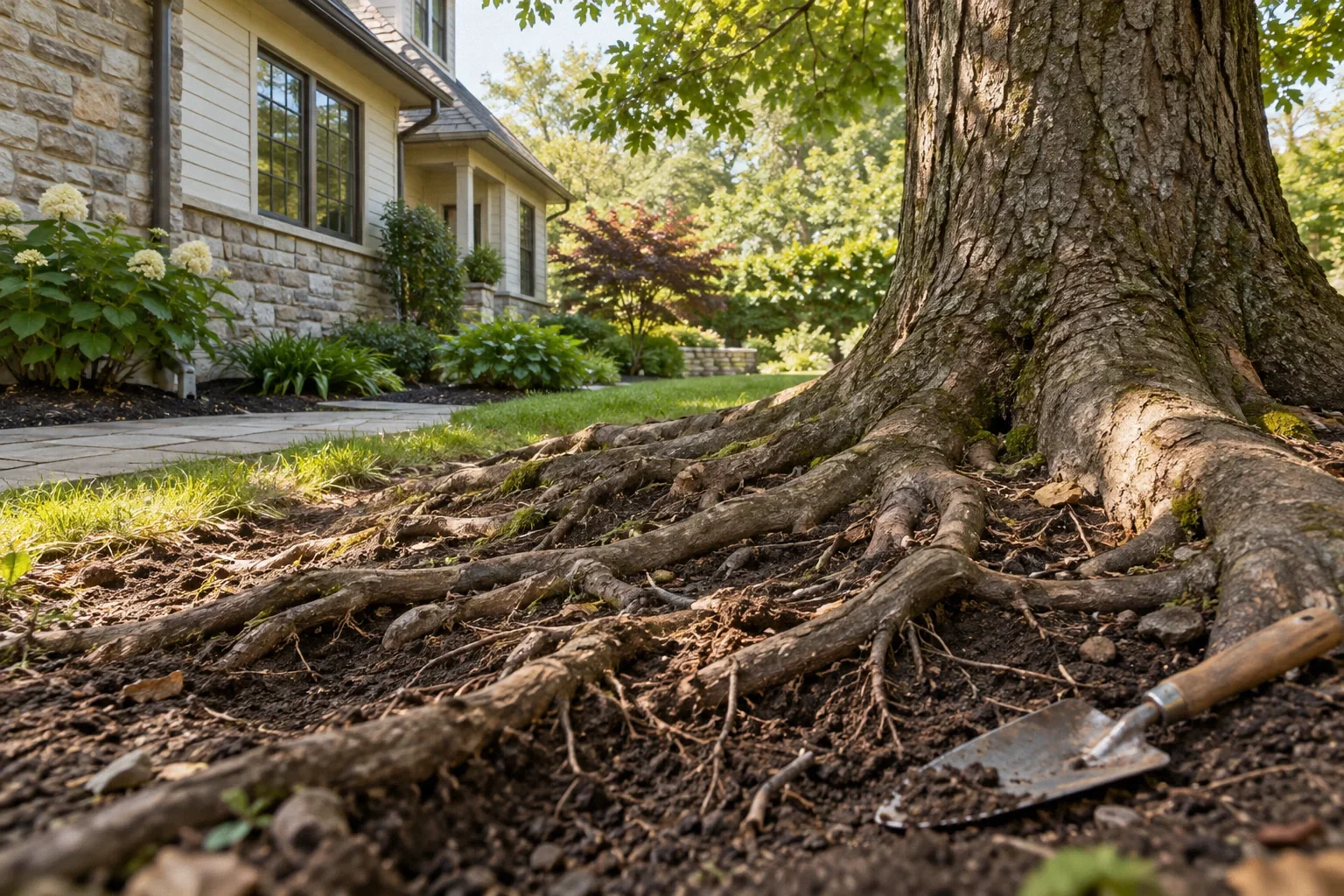
Collect the evidence you already have: the original soil report, inspection findings, recent water bills, irrigation repairs and photographs of soil and building changes. Check accessible drainage and irrigation for obvious malfunction without excavating beside footings or cutting roots. Record concerns that need a specialist rather than trying to resolve them through aggressive wetting or drying.
The next step is a focused local assessment when the soil behavior or symptoms remain unclear. Explain the practical question: whether current moisture management is appropriate and whether observed changes warrant further investigation. That is more useful than asking for permission to follow a generic foundation-watering schedule. The answer should fit the house, ground and climate together.
Before your next decision
- Identify whether soil information is measured, mapped or anecdotal.
- Map runoff, irrigation, leaks and paved areas around the house.
- Document surface gaps separately from building symptoms.
- Ask for the objective and limits of any moisture-management recommendation.
- Reassess after material changes in drainage, vegetation or plumbing.
Related questions
Does a soil gap prove the foundation is damaged?
No. It records a surface condition. The significance depends on building observations, ground conditions and any evidence of movement over time.
Should everyone with clay soil use a soaker hose?
No. Clay behavior, drainage, paving, irrigation and foundation configuration vary. A device or schedule appropriate at one property may be unsuitable at another.
Can watering reverse settlement?
Do not assume so or use irrigation as a lifting method. Establish the cause of movement and the intended response with appropriate local expertise.
Sources & further reading
- Colorado Geological Survey / American Society of Civil EngineersHome Construction on Shrinking and Swelling Soils, Special Publication 11
October 1978 historical educational text. Use stable soil mechanisms only; exclude dated loss statistics, design dimensions and Colorado rules from California advice.
- U.S. Department of Energy, Building Science EducationLand is Graded: Final Grade Slopes Away from Foundation
General drainage guidance. Its dimensions are guidance, not independently verified California or local code.
- U.S. Department of Energy, Building Science EducationFoundation Drain Gutters Downspouts
Roof-water management, separate from interior waterproofing systems.
- USDA Natural Resources Conservation ServiceSoil Surveys Can Help You
Planning-level soils information; not a substitute for parcel-specific subsurface investigation.
Homeowner questions behind this article
These discussions informed the questions, not the technical answers. Some were available through indexed excerpts; votes and comments are not an engineering assessment.
Research method